
A research team led by Professor Sun Fei from the School of Energy Science and Engineering at Harbin Institute of Technology (HIT) has achieved advances in carbon-based electrocatalytic energy and mass conversion.
Their findings were published in Joule (selected as a cover article) and Nature Communications, under the titles "Multiscale mass transfer at carbonaceous catalyst-mediated electrocatalytic interface" and "Unveiling the coupling effect of sp2 domain size and local active sites in switching the selectivity of nanocarbon catalysts toward the oxygen electro-reduction", respectively.
Energy conversion at the carbonaceous electrocatalytic interface is characterized by intricate coupling effects that extend from atomic-scale active sites to macroscopic electrode structures. To date, revealing the working mechanisms of functional units across various scales and bridging the gap between the performance of industrial devices and the intrinsic properties of materials remain critical challenges.
In response to mass transfer bottlenecks, the team introduced a systematic theoretical framework for the carbon-mediated electrocatalytic interface in the Joule study. Beyond the conventional viewpoints of active-site engineering, this framework establishes a comprehensive multiscale mass transfer path from macroscale electrodes through mesoscale nanopores to nanoscale surfaces. This path provides theoretical guidance and engineering strategies for scaling up technologies that reduce carbon dioxide, oxygen, and nitrogen from the laboratory to industrial applications.
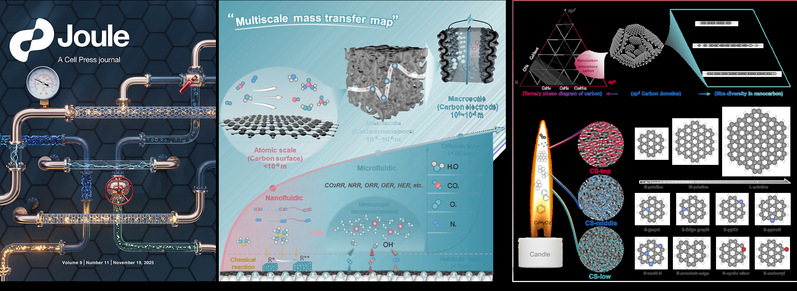
Investigation into the mechanism of carbon-based electrocatalytic energy and mass conversion. Left: The study that was chosen as the Joule cover article; Middle: The multiscale mass transfer path at the carbonaceous electrocatalytic interface; Right: The coupling effect between local active sites and sp2 domain size of nanocarbon. [Photo/hit.edu.cn]
In the Nature Communications study, the team resolved the selectivity controversy between the production of water for fuel cells and hydrogen peroxide for green synthesis by identifying a previously overlooked coupling mechanism between sp2 domain size and local active sites in the oxygen reduction reaction. By integrating size-controllable model catalysts, in situ spectroscopy, and multiscale calculations, they demonstrated that sp2 domain size determines the generation and desorption of key intermediates, whereas active sites determine the types of intermediates. Using p-band theory, the team clarified the electronic origins of these catalysts, providing new criteria for developing high-performance catalysts.
HIT is the first and corresponding institution for both papers. Professor Sun is the corresponding author, with PhD student Yang Chaowei serving as the first author of both papers. Professor Liu Shaoqin from HIT's Faculty of Life Science and Medicine and Professor Lu Yunfeng from Beijing University of Chemical Technology served as co-corresponding authors in Joule and co-authors in Nature Communications.