

The research team led by Professor Wang Zhenbo from the School of Chemistry and Chemical Engineering at Harbin Institute of Technology (HIT) has recently made significant progress in hydrogen fuel cell electrocatalysts.
The team utilized the electric field effect of dipoles to improve the activity and stability of cathode ORR catalysts. The research findings were published in Angewandte Chemie International Edition under the title Dipoles Effect in Fe-N-C Catalyst by High-energy p Orbitals for Enhanced Acidic Oxygen Reduction Reaction. The study is expected to provide new insights into the design and application of next-generation cathode catalysts for hydrogen fuel cells.
Due to the challenge of maintaining the stability of cathode catalysts under high current and long-term operating conditions, their large-scale development has been hindered.
Professor Wang's team introduced atoms from the nitrogen group, which have the same number of valence electrons as nitrogen, near the FeN4 active sites to form dipoles. These dipole-induced electric fields enhance the activity and stability of the cathode catalyst. Theoretical calculations indicate that the introduction of nitrogen group atoms increases the spin polarization of Fe, breaks the charge symmetry near the Fe sites, and causes electron rearrangement in the three-D orbitals of Fe atoms as the atomic number increases down the group. Experimental results demonstrate that the introduction of these dipoles improves the activity and stability of Fe-N-C catalysts. Proton exchange membrane fuel cells assembled with this catalyst exhibit a high peak power density. This design strategy is expected to address the limited activity of cathode catalysts and provide theoretical guidance for the design and development of highly active non-precious metal cathode catalysts.
HIT is the first corresponding institution of the paper. PhD student Yang Chen from HIT's School of Chemistry and Chemical Engineering is the first author. Professor Wang, Professor Zhao Lei, and Associate Professor Zhang Yunlong from HIT’s School of Chemistry and Chemical Engineering, and Postdoctoral Researcher Shen Lixiao from Shenzhen University are co-corresponding authors. PhD students Liu Bo, Dai Yunkun, Zhang Ziyu, Xu Xiaochun, Zhang Wenchao, Guo Pan, and Liu Bing from HIT’s School of Chemistry and Chemical Engineering, PhD student Zhao Zigang from Harbin Engineering University, and Professor Chen Aibing from Hebei University of Science and Technology are co-authors of the paper.
This research was supported by the National Natural Science Foundation of China (U23A20573, 22579039, and 22409041), the Shandong Provincial Key Research and Development Program (2022CXGC010305), the Heilongjiang Provincial Natural Science Foundation (LH2024B013), and others.
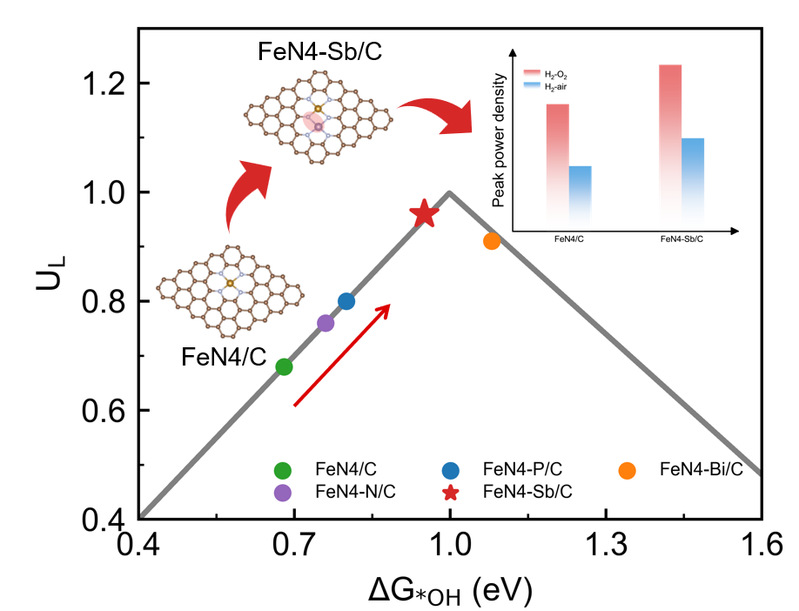
A diagram on enhancing oxygen reduction reaction activity via the dipole effect. [Photo/hit.edu.cn]