

A research group led by Professor Huang Xiaoxiao, within the team headed by Academician Zhou Yu from the School of Materials Science and Engineering at Harbin Institute of Technology (HIT), has achieved significant progress in developing flexible electromagnetic wave absorbers for multi-scenario applications. The research findings were published in Advanced Functional Materials under the title Lightweight and Flexible Fabric Assembled by ANF/GMWCNT Fibers for Broadband Electromagnetic Wave Absorption.
The research team prepared an aramid nanofiber (ANF)/graphitized multiwall carbon nanotube (GMWCNT) composite fiber (AGCF-x, where x denotes the mass ratio of GMWCNT to ANF) via a wet-spinning and sol-gel transformation strategy, subsequently weaving the fibers into fabric (AGCFF-x). Following protonation, the ANF formed a 3D structure under the barrier effect of the GMWCNT, serving as the fiber support skeleton, with an optimal tensile stress of 30.25 million pascals (MPa). Linear GMWCNTs are adsorbed around the ANF and interdigitate with one another, naturally forming a 3D conductive network that subsequently induces conductive loss and interfacial polarization loss in electromagnetic waves.
As the carbon nanotube content in the composite fiber increases, the fabric's ability to dissipate electromagnetic waves progressively enhances. However, excessively high concentrations may cause impedance mismatch in the material, leading to the reflection of electromagnetic waves and the loss of effective absorption properties. When the mass ratio of ANF to GMWCNT is 1:2, the fabric (AGCFF-2) achieves a minimum reflection loss of -75.18 dB and an effective absorption bandwidth of 7.68 gigahertz (GHz).
To simulate complex operational environments, the fabric underwent thermal treatment (AGCFF-x-T). Its further-regulated structure, featuring optimized pores and functional groups, enhanced impedance matching and polarization capability, thereby broadening the effective absorption bandwidth to 8.02 GHz. Far-field simulation results indicate that the radar cross-section (RCS) of this fabric can be optimally reduced by 31.68 dBm^2, demonstrating its electromagnetic stealth potential. Furthermore, the fabric possesses joule-heating capabilities, exhibiting rapid joule-heating response and excellent cyclic durability. Under an applied voltage of 10 volts (V), the surface temperature can reach 105.5 C.
HIT is the sole corresponding institution for the paper. Master's student Chen Tao from HIT's School of Materials Science and Engineering is the first author, with Professor Huang and doctoral student Yan Yuefeng as co-corresponding authors.
This research was supported by the National Natural Science Foundation of China and other projects.
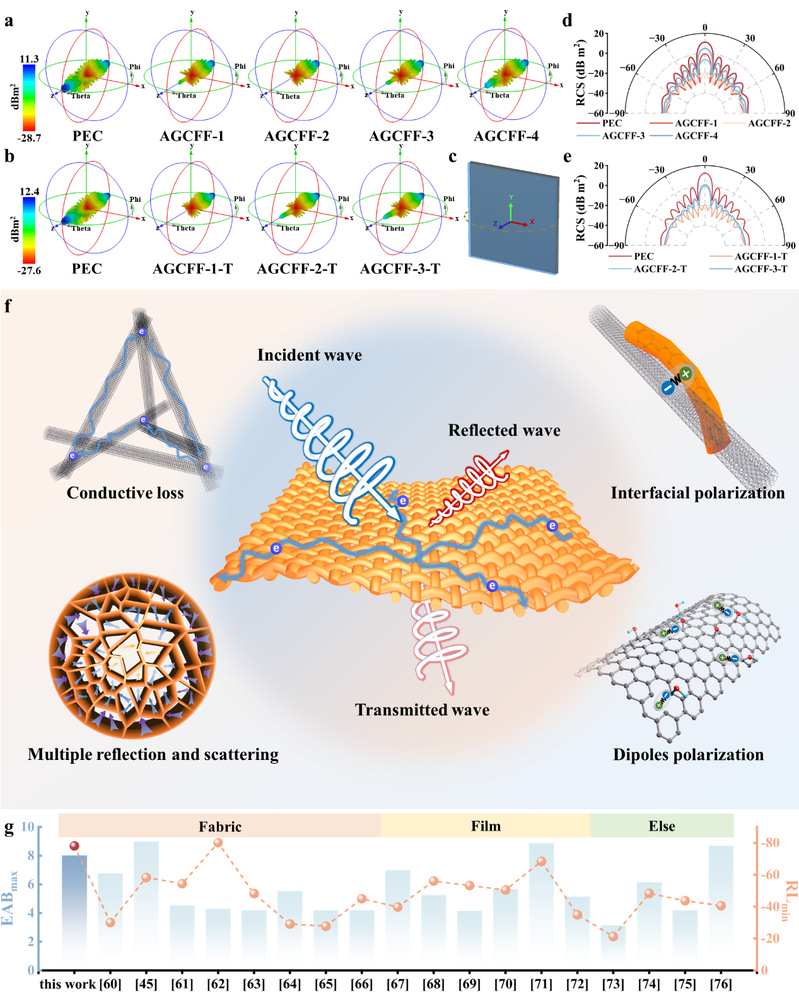
Figure: 3D RCS simulation results: (a) AGCFF-x, (b) AGCFF-x-T. (c) Schematic illustration of the perfect electric conductor (PEC) model covered with an absorber coating. RCS plots in 1D polar coordinate system: (d) AGCFF-x and PEC, (e) AGCFF-x-T and PEC. (f) Schematic illustration of the multiscale electromagnetic wave absorbing mechanism in fabric. (g) Comparison of electromagnetic wave absorbing performance in the field of flexible materials
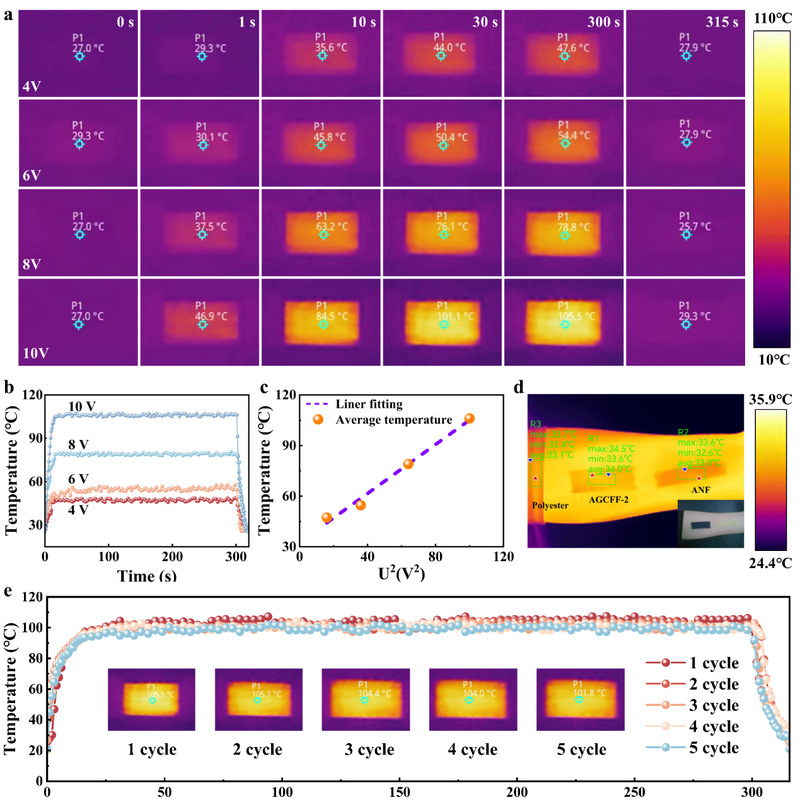
Figure: Joule heating performance of AGCFF-2. (a) Infrared thermal images and (b) time-dependent temperature graphs of AGCFF-2 under different voltages. (c) Experimental data and linear fitting of saturation temperature versus U2. (d) Heat dissipation of AGCFF-2. (e) Cyclic stability of AGCFF-2 under 10 V for five consecutive cycles.