

A team led by professors Shuai Yong and Wang Zhaolong from the School of Energy Science and Engineering at Harbin Institute of Technology (HIT), in collaboration with Chair Professor Wang Zuankai from Hong Kong Polytechnic University, summarized recent research progress in bionic-structured milli-fluidics and its application prospects across multiple cutting-edge fields.
The research, published in the journal Chemical Reviews under the title Bionic Structured Milli-fluidics: A Review, elaborates on the principles of bionic structural design, the mechanisms of passive and active droplet manipulation, and the broad applications of this technology in areas such as fog collection.
Distinct from microfluidics and macroscale fluid characteristics, bionic structured milli-fluidics is an emerging field at the intersection of fluidics and bionics that aims to achieve precise control over droplet behaviors, including motion, coalescence, and splitting, at the millimeter scale. This technology constructs fluid-interface systems with capabilities for directional transport, intelligent response, and multi-task execution by imitating natural organisms with unique surface structures, such as Araucaria leaves, and by combining surface wettability gradients with external energy fields, such as light.
Addressing the core challenge of achieving efficient, controllable, and multifunctional millimeter-scale droplet manipulation, the review systematically outlines two technical approaches: passive manipulation (relying on bionic structures) and active manipulation (relying on external stimuli). For passive manipulation, it utilizes Laplace pressure differences, capillary action, and surface energy gradients to drive autonomous droplet motion by designing asymmetric surface wettability, geometric-gradient structures, and geometrically anisotropic structures. For active manipulation, it employs external stimuli, including photothermal effects, electric-field modulation, magnetic-field response, and acoustic-field manipulation, to achieve real-time, programmable control over droplet position, morphology, and dynamics.
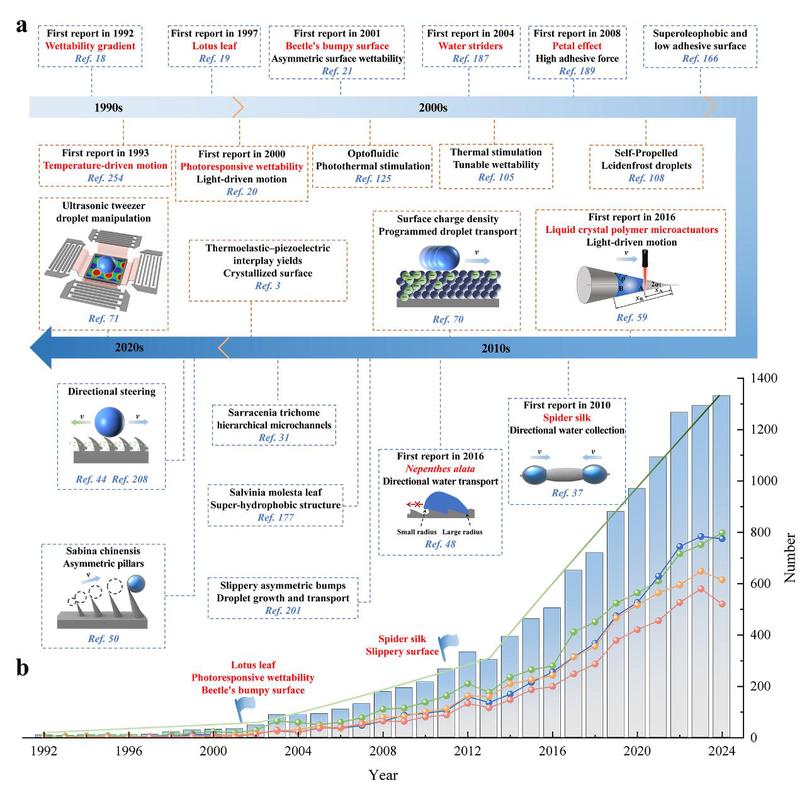
The development history of bionic structured milli-fluidics technology. [Photo/hit.edu.cn]
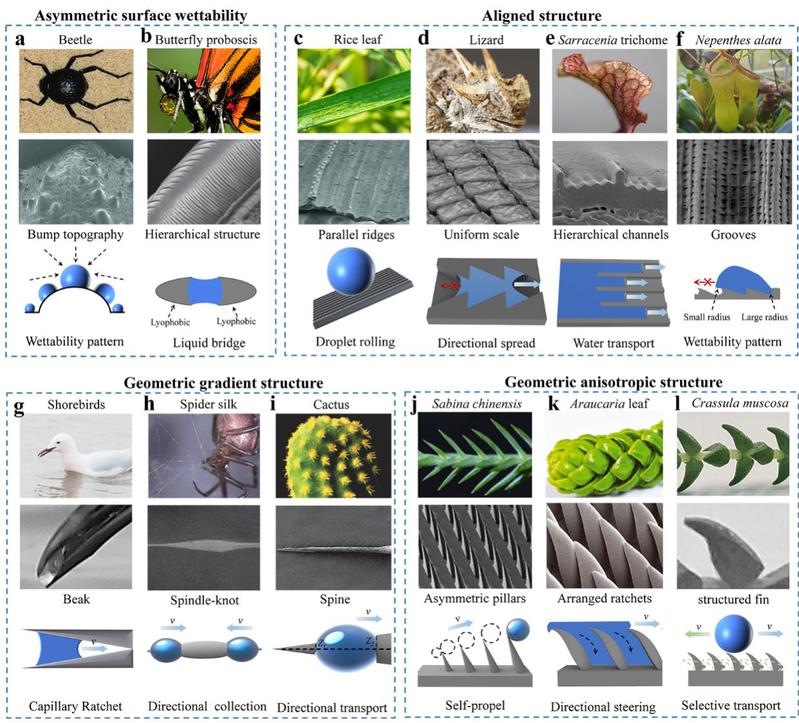
Representative bionic structured milli-fluidics. [Photo/hit.edu.cn]
The article further summarizes the applications of bionic-structured milli-fluidics in emerging fields such as all-weather fog collection. This review not only introduces the concept of milli-fluidics for the first time but also serves as a reference for researchers to master advanced millimeter-scale droplet manipulation techniques and to design bionic structures. It also lays a theoretical foundation for advancing the field toward intelligence, integration, and multifunctionality.
Assistant Researcher Xie Mingzhu from HIT's School of Energy Science and Engineering is the first author. Professor Shuai, Professor Wang Zhaolong, and Chair Professor Wang Zuankai are the corresponding authors. This research was supported by projects such as the National Natural Science Foundation of China and key research and development programs.