

The project "Convention, Exhibition and Hotel Complex of Taizicheng Snow Town, Zhangjiakou Olympic Zone of the Beijing 2022 Winter Games", designed by the Architectural Design and Research Institute Co of Harbin Institute of Technology (HIT) with Academician Mei Hongyuan as chief designer, has received the 2026 German Design Award.
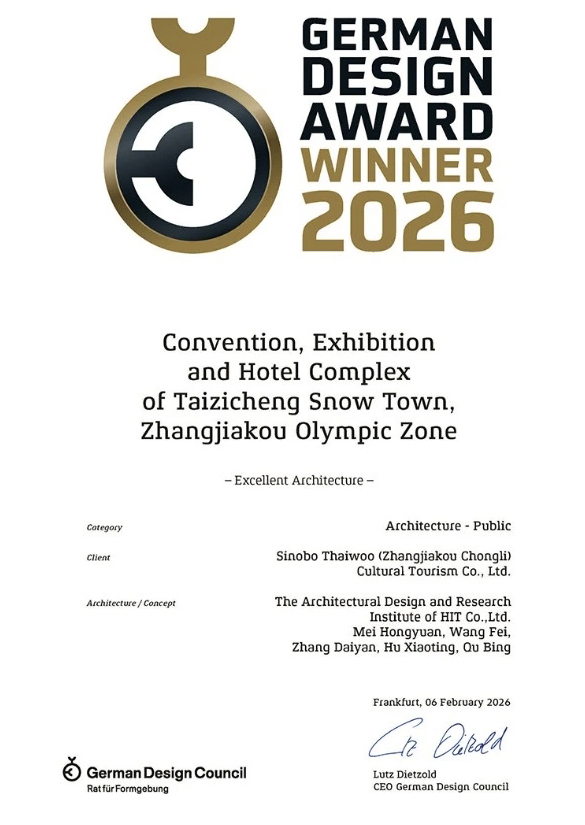
The award certificate. [Photo/hit.edu.cn]
The complex serves as a major facility in the Zhangjiakou Olympic Zone of the Beijing 2022 Winter Games. Led by Academician Mei – a leading figure in cold-region architecture and sports architecture design in China – the design reflects careful consideration of the mountainous natural environment. With a commitment to "respecting nature, conserving resources, featuring Chinese style, and upholding international standards", the project seeks to improve spatial organization efficiency, adopt green and low-carbon technologies, pursue a locally rooted architectural aesthetic, and coordinate multiple functional uses. It integrates the cultural depth of the East with a modern international style, linking the complex through a "dragon bridge" that unfolds the composition in a continuous sequence and expresses the grandeur and humanistic spirit of northern China's mountain architecture.
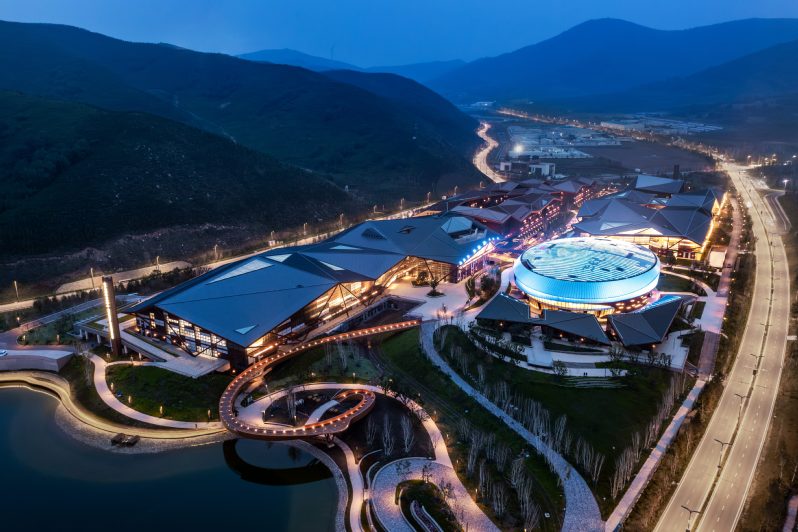 The award-winning complex. [Photo/hit.edu.cn]
The design, characterized by ecological integration, respects Chongli's unique natural terrain to the greatest extent possible, preserving the distinctive landscape of two mountains flanking a valley. Responding to the topography, it integrates elevation differences, water systems, and natural features to create spaces where architecture and nature interweave, allowing the buildings to become an organic extension of the mountain’s contours. The bold yet simple triangular folded-plate roofs help deflect wind and guide snow, reducing snow loads, while the strong supporting steel frames on the facades form a rhythmic, undulating cluster of structures. Together, they echo both the cultural essence of traditional Chinese timber construction and the snowy character of Chongli’s continuous mountain ranges.
The design pursues a spatial organization strategy, which integrates conference, exhibition, hotel, commercial, and dining functions into an all-season complex. Corridors and an underground sunlit "warm street" connect the various functional clusters, mitigating the effect of the harsh climate on public life while establishing a new benchmark for post-Games sustainable operation and the long-term regional development of ice-and-snow architectural complexes.
In terms of technological innovation, the design incorporates advanced technologies within complex building systems to ensure low-energy operation and efficient use of clean energy. It addresses technical challenges related to large-span, complex forms embedded in mountainous terrain and introduces a new transportation organization model for large cultural and tourism developments in cold regions by combining a TOD approach with intelligent traffic management systems. These innovations not only meet the high service standards required for the Winter Olympics but also establish a sustainable model that promotes green construction and advances intelligent building technologies.
The German Design Award, is issued by the German Design Council and recognizes outstanding design achievements from around the world that demonstrate innovation and social impact. It is widely regarded as an influential accolade that helps shape design trends and enjoys strong international recognition and authority.
The complex has also received numerous domestic and international honors and nominations, including the first prize for architectural design in the National Excellent Engineering Survey and Design Awards of the China Engineering and Consulting Association, the BLT Built Design Awards, the World Design Awards by The Architecture Community (TAC), the American AMP Architecture MasterPrize, and the International Design Awards (IDA).
Editors: Shang Yankai, Yang Wenyu
Reviewed by: Song Ling, Li Shoubin