

The research team led by Professor Song Qinghai and Professor Zhou Yu from the School of Integrated Circuits at Harbin Institute of Technology's Shenzhen campus (HITSZ), in collaboration with Professor Ou Xin from the Shanghai Institute of Microsystem and Information Technology, Chinese Academy of Sciences, and Professor Adam Gali from the HUN-REN Wigner Research Centre for Physics, saw their paper titled Strain-Enhanced Spin Readout Contrast in Silicon Carbide Membranes [Phys. Rev. Lett. 135, 110601 (2025)] selected for the Physical Review Letters 2025 Collection of the Year. It is one of only seven papers selected globally in the field of quantum information science and technology.
As a wide-bandgap semiconductor material, silicon carbide (SiC) holds broad application prospects in quantum sensing, quantum communication, and quantum computing. However, achieving high-fidelity readout of spin states at room temperature has long remained a core challenge in this field. The research team systematically revealed the modulation mechanism of strain on the intersystem crossing rates between spin energy levels, demonstrating that strain engineering can serve as a universal strategy to enhance the room-temperature spin readout contrast of SiC qubits to over 60 percent. This breakthrough lays a crucial foundation for the development of high-performance quantum devices operating at room temperature.
As a highly prestigious journal in the field of physics, Physical Review Letters publishes approximately 2,500 letters annually, of which only about 400 are highlighted as editors' suggestions. To further spotlight breakthrough achievements of immense scientific value, the editorial board handpicks roughly 60 papers from this group to compile the Collection of the Year. In the 2025 Collection, seven papers worldwide were selected in the Quantum Information Science and Technology category, five of which originated from Chinese research institutions.
This research was supported by the National Natural Science Foundation of China, the Guangdong Provincial Key Area Research and Development Program, and the Shenzhen Science and Technology Plan.
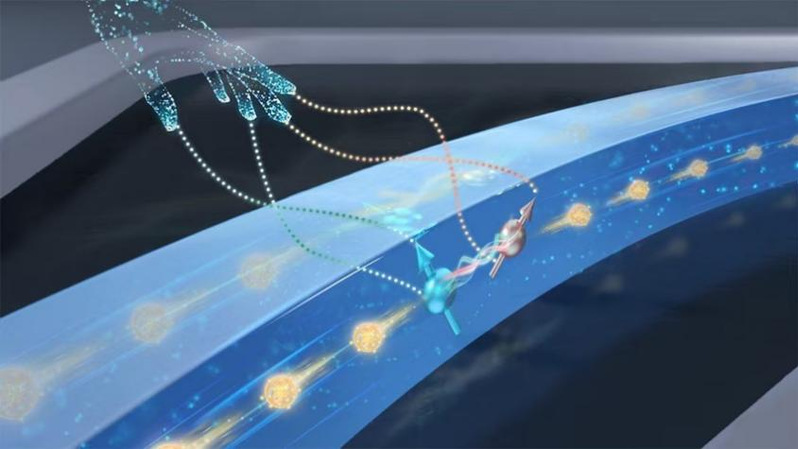 The schematic diagram of the research content. [Photo/hit.edu.cn]