

A team led by professors Shuai Yong, Zhang Yaning, and Associate Professor Pan Ruming from the School of Energy Science and Engineering at Harbin Institute of Technology (HIT) has made significant progress in plastic waste valorization.
The team proposed a monolithic heating method based on electromagnetic induction, enabling rapid volumetric heating and efficient pyrolysis-catalysis conversion of waste plastics through porous metal catalysts, achieving the highest carbon recovery efficiency to date. The relevant findings, titled Enhancing carbon nanotubes production from pyrolysis-catalysis of plastic waste through monolithic heating, were published in National Science Review.
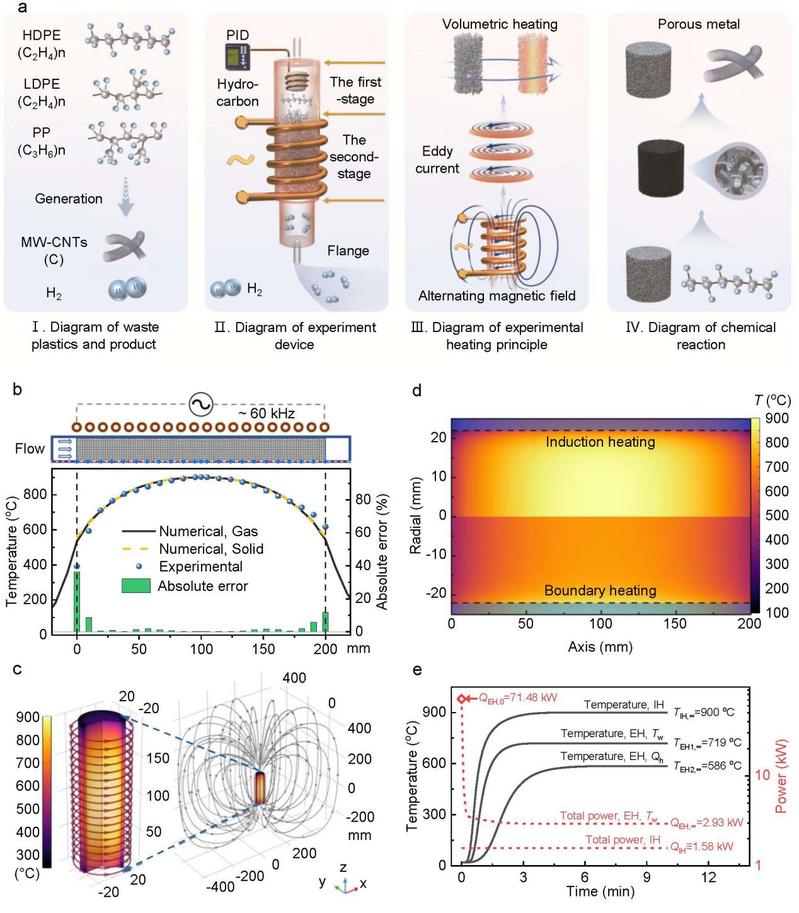
The schematic diagram of carbon nanotube preparation via plastic waste pyrolysis-catalysis using a porous metal catalyst heated by electromagnetic induction. [Photo/hit.edu.cn]
To address the common problems of low energy efficiency and uneven reactions in traditional electric heating, the team combined electromagnetic induction heating technology with porous metal catalysts, achieving precise control and enhancement of the catalytic reaction process. This significantly improved the heat and mass transfer efficiency of the reaction system, providing a novel technical pathway for the chemical recycling of waste plastics.
The research team elucidated the mechanisms of different metal catalysts in the catalytic reforming process, clarifying the regulatory law of catalyst interface characteristics on carbon nanotube nucleation and growth, providing a theoretical basis for the design of high-performance catalysts. The prepared carbon nanotubes show broad application prospects in energy storage and thermal management. Further techno-economic analysis shows that this process has significant advantages, offering practical support for the industrialization of plastic waste valorization.
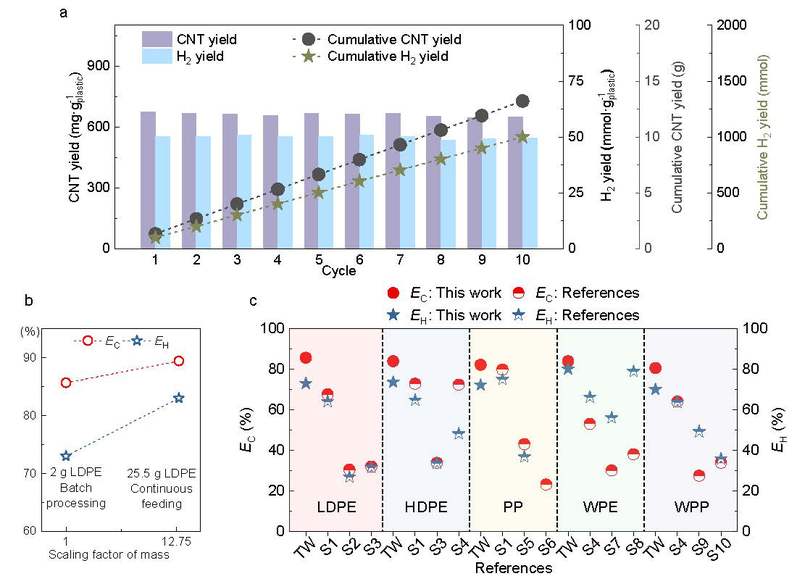
Comparison of cycle stability and catalytic efficiency of iron porous catalysts. [Photo/hit.edu.cn]
Associate Professor Pan is the first author of the paper. Doctoral students Yu Jie and Yang Youwei from the School of Energy Science and Engineering, along with Professor Ilman Nuran Zaini from Institut Teknologi Bandung, are co-first authors. Professor Shuai, Professor Zhang, and Associate Professor Pan are the co-corresponding authors.
This research was supported by the National Natural Science Foundation of China and the National Key Research and Development Program of China.
Paper link: https://doi.org/10.1093/nsr/nwag143