

Harbin Institute of Technology Media (text by Simiao Kan and Zhenbo Wang, image by Zhenbo Wang)
Professor Wang Zhenbo's research team from the School of Chemistry and Chemical Engineering at Harbin Institute of Technology (HIT) recently made progress in the research of electrocatalysts for proton exchange membrane fuel cells.
The team proposed a hydrogen embrittlement-like assisted thermal activation strategy to construct atomically dispersed catalysts. The research findings, titled Synthesis of atomically dispersed catalysts via hydrogen embrittlement-like assisted thermal activation for acidic oxygen reduction, have been published in the journal Nature Communications.
This achievement is expected to provide new insights for the design and application of next-generation cathode catalysts for proton exchange membrane fuel cells.
Addressing the scientific challenge that 4d/5d transition metals are difficult to form single-atom dispersed states due to their high cohesive energies, Professor Zhenbo Wang's team proposed a hydrogen embrittlement-like assisted thermal activation strategy.
The core mechanism of this strategy lies in utilizing hydrogen penetration to weaken the metal-metal interactions within 4d/5d metal clusters during high-temperature synthesis. As hydrogen diffuses into the interior of metal clusters, it promotes their collapse into individual metal atoms, which are subsequently anchored by nitrogen dopants in the carbon support, ultimately forming stable M-N4 single-atom active sites.
Taking ruthenium as a model system, the research team provided conclusive evidence for the above mechanism through ex-situ electron microscopy and spectroscopic characterization analyses: during hydrogen-assisted thermal treatment, hydrogen penetration can disrupt Ru-Ru bonding, facilitating the transformation of ruthenium clusters into isolated M-N4 sites.
Experimental results demonstrate that the NC-Ru-950 catalyst prepared by this method exhibits excellent catalytic activity and stability in acidic oxygen reduction reactions and proton exchange membrane fuel cells. This work has developed an efficient and universal strategy for stabilizing 4d/5d transition metals as single-atom catalysts, offering promising insights for constructing high-performance electrocatalysts.
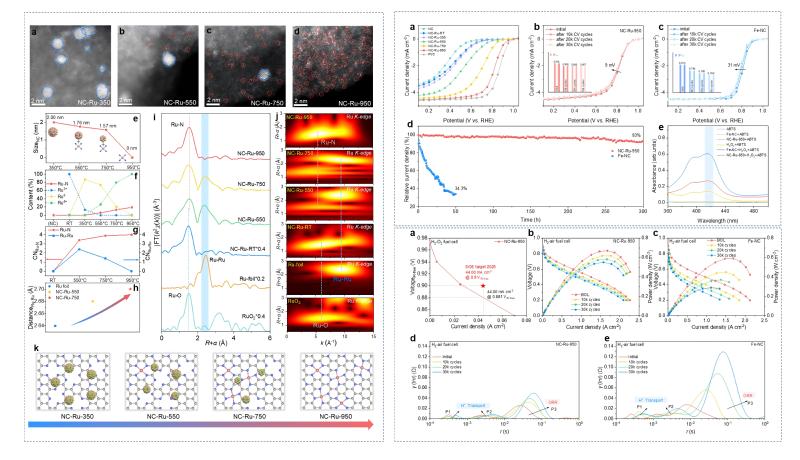
A schematic illustration of the hydrogen embrittlement-like assisted thermal activation strategy for constructing atomically dispersed ruthenium (Ru)-based catalysts. [Photo/hit.edu.cn]
HIT is the first corresponding institution named in the paper.
Guo Pan, a doctoral student from the School of Chemical Engineering and Chemistry, is the first author. Professor Wang Zhenbo, Professor Zhao Lei, Associate Professor Zhang Yunlong from the School of Chemical Engineering and Chemistry, and Postdoctoral Researcher Shen Lixiao from Shenzhen University are the co-corresponding authors.
Co-authors include doctoral students Dai Yunkun, Liu Bing, Ma Miao, Liu Bo, and Zhang Ziyu from the School of Chemical Engineering and Chemistry, doctoral student Zhao Zigang from Harbin Engineering University, and Professor Chen Aibing from Hebei University of Science and Technology.
This research was supported by the National Natural Science Foundation of China, the Shandong Key Research and Development Program, the Heilongjiang Provincial Natural Science Foundation, and other projects.
Paper Link: https://www.nature.com/articles/s41467-026-71340-z