

The research team led by Professor Pan Yunlu from the State Key Laboratory of Robotics and System and the School of Mechatronics Engineering at the Harbin Institute of Technology (HIT) has recently made important progress in the research of high-quality-factor (high-Q) non-local metasurfaces.
The team proposed a guided-lattice resonances (gSLRs) model, overcoming the physical limitation that surface lattice resonance (SLR) metasurfaces struggle to achieve high Q-factors in index-discontinuous environments.
The relevant research results were published in Nature Communications under the title High-Q Multimodal Guided-Surface Lattice Resonances in Index-Discontinuous Environments, providing important theoretical support for the research and development of ultra-thin integrated nanophotonic and optoelectronic devices.
SLRs in metasurfaces have broad application potential in the field of subwavelength devices, owing to unique advantages such as high Q-factors, remarkable localized field enhancement, and extensive long-range interactions. However, existing SLR metasurfaces can only realize high Q-factors in isotropic environments, which greatly restricts their practical application in typical fields such as biosensing.
To address this issue, the team conducted an in-depth investigation into the core theoretical reasons for the difficulty in achieving high-Q SLR metasurfaces in index-discontinuous environments, and proposed an innovative gSLR configuration. By embedding the nanoparticle arrays into slab waveguides, this configuration precisely regulates the far-field radiation pattern of nanoparticles via the waveguide, effectively enhancing the coupling between nanoparticles, and ultimately realizing high-Q gSLRs in index-discontinuous environments. By adjusting the number of guided modes in the waveguide, multimodal resonances can be achieved without altering the superlattice configuration, offering a convenient approach to research on multi-wavelength light–matter interactions.
In addition, the research team proposed a biomolecule detection method based on the gSLR metasurfaces. The team established a mathematical sensing model for guided-mode lattice resonance metasurface biosensors by integrating the theory of gSLRs with biochemical reaction kinetics and verified the feasibility and reliability of the method through typical biomolecule detection experiments. This provides important technical guidance and a practical model for the development of novel nanophotonic biosensors.
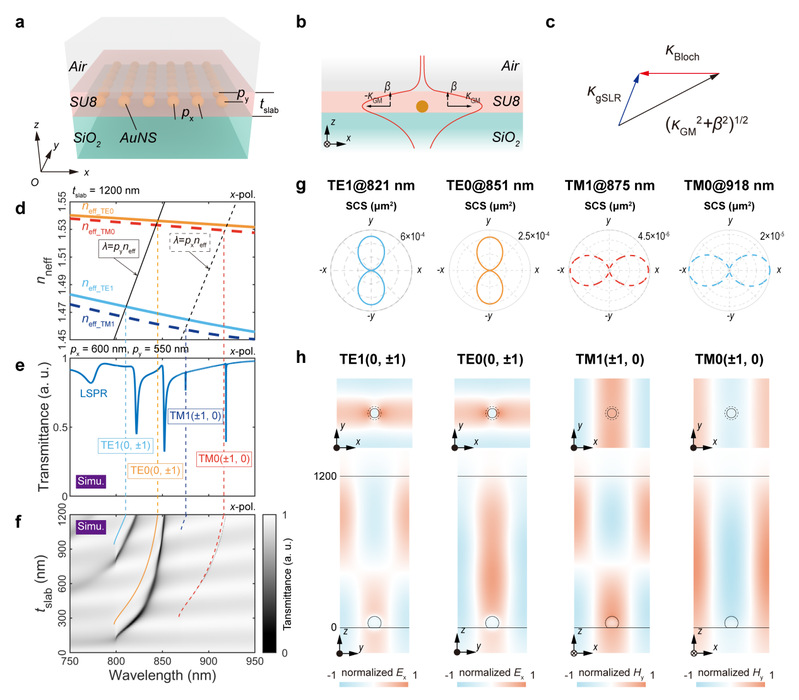
Principles of gSLR in index-discontinuous environments. [Photo/hit.edu.cn]
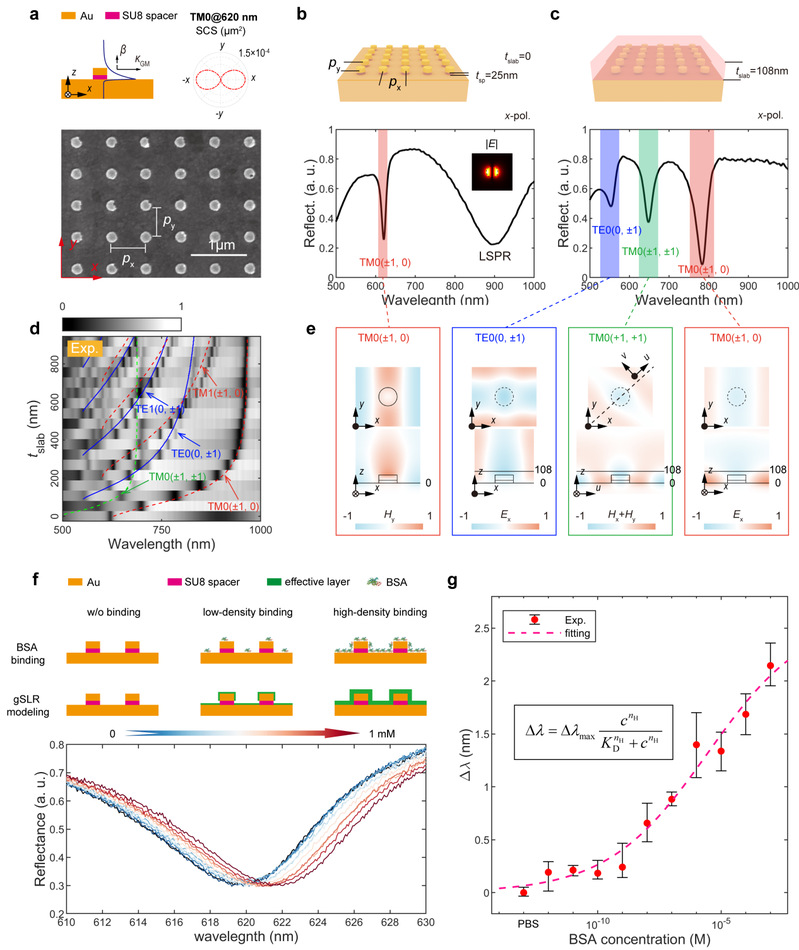
Biomolecule detection realized by gSLR metasurfaces. [Photo/hit.edu.cn]
The first corresponding affiliation of the paper is the State Key Laboratory of Robotics and System. The first author is Huang Suichu, an associate researcher from the School of Mechanical and Electrical Engineering. Co-corresponding authors include Professor Ding Xumin from the School of Instrument Science and Engineering, Professor Zhao Xuezeng from the School of Mechatronics Engineering, Professor Zheng Yuebing from the University of Texas at Austin, and Professor Pan Yunlu from the School of Mechatronics Engineering.
The project was supported by the National Natural Science Foundation of China, the Independent Research Project of the State Key Laboratory of Robotics and Systems at HIT, and the Temple Foundation.
Paper Link: https://www.nature.com/articles/s41467-026-71583-w