
Shao Lu, a professor at the School of Chemistry and Chemical Engineering at Harbin Institute of Technology (HIT) and a member of the State Key Laboratory of Urban-rural Water Resource and Environment, together with Associate Professor Yang Xiaobin, has developed a biomimetic catalytic self-cleaning water treatment membrane.
The related research, titled Lotus-leaf-mimetic catalytic cleaning membranes with enriched oxygen vacancies for efficient water purification, was published in Nature Communications. This achievement provides a new technical route for the development and wide application of high-efficiency, low-carbon water treatment membrane materials.
Pressure-driven separation membranes are key technologies supporting the sustainable development of the energy-water system. However, membrane fouling has long restricted the practical application of separation membranes. Traditional hydrophobic polymer membranes are easily clogged by organic pollutants during water treatment, leading to reduced flux, frequent cleaning, and high operating costs. Off-line cleaning also has drawbacks such as high resource consumption and significant environmental impacts.
Inspired by the hierarchical micro-structure and self-cleaning properties of natural lotus leaves, the team innovatively adopted a mild two-step interfacial construction strategy. First, an HHTP-Co metal-organic interlayer was built on the hydrophobic polymer membrane substrate. It then mediated the controllable mineralization of manganese dioxide, converting an ordinary hydrophobic membrane into a novel membrane material with triple functions: superhydrophilicity, underwater superoleophobicity, and catalytic self-cleaning.
The biomimetic membrane features a raspberry-like micro-nano structure on the surface and a dynamic water-pocket barrier similar to the nano-micro air chambers of lotus leaves at the interface. Meanwhile, a large number of oxygen vacancies are generated during heterogeneous mineralization, greatly enhancing the membrane's catalytic decontamination capability. It exhibits excellent antifouling and in-situ regeneration performance in oily wastewater treatment.
Theoretical calculations reveal the strong coordination mechanism between the interlayer and metal ions, providing theoretical support for the design and preparation of similar biomimetic catalytic membranes. The team also proposed an evaluation model for membrane antifouling merit, and the antifouling figure of merit of the modified membrane is 24.8 times that of the control membrane.
The modified membrane maintains sound separation performance and structural integrity under complex conditions such as acid, alkali, and salt, and can be widely used in industrial oily wastewater purification, municipal sewage treatment, drinking water safety guarantee, and other fields.
HIT is the first corresponding affiliation of this paper. Associate Professor Yang Xiaobin is the first author. Professor Shao, Academician Bhekie B. Mamba from the University of South Africa, and Professor Alicia Kyoungjin An from the Hong Kong University of Science and Technology are the co-corresponding authors. Academician Ma Jun from the School of Environment, doctoral candidates Bao Hongfei, Wang Haoyang and Li Yangxue, and master’s students Gao Runliang and Wang Xinyu from the School of Chemistry and Chemical Engineering participated in the related research.
This research was supported by the National Natural Science Foundation of China, the Fundamental Research Funds for the Central Universities, and the Independent Project of the State Key Laboratory of Urban-rural Water Resource and Environment.
Paper link: https://doi.org/10.1038/s41467-026-72088-2
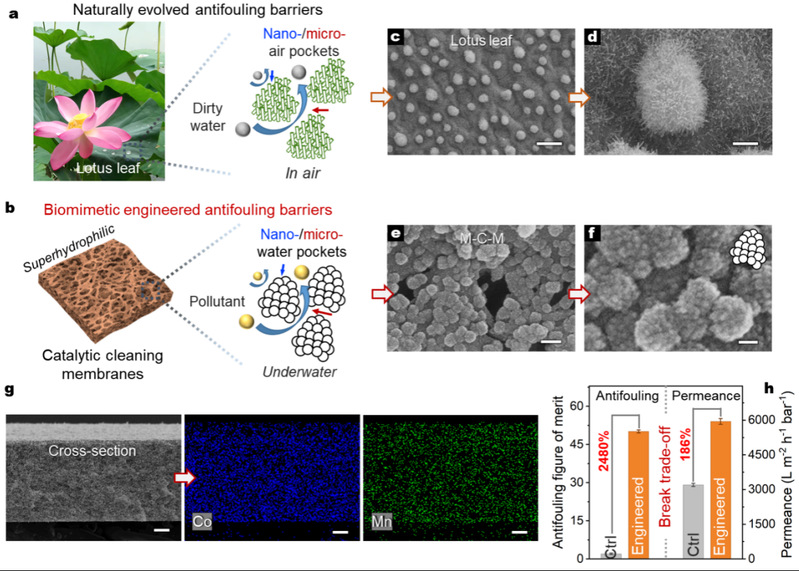
(a, b) A scheme of lotus-inspired interface antifouling engineering on polymeric membranes with a catalytic cleaning function via the formation of nano/micro-water pockets via mimicking nano-/micro air pockets among microscopically structured mountains and valleys of a lotus leaf. SEM images of the surfaces of (c, d) a lotus leaf and (e, f) the membrane with the Co-HHTP-mediated MnO2 mineralization (M-C-M). Scale bars in d to g are 20 μm, 2 μm, 200 nm, and 50 nm. (g) EDS mapping images (Co, Mn) of the cross-section of M-C-M. Scale bars are 30 μm. (h) The resulting membrane breaks the trade-off between the antifouling figure of merit and permeance (for the emulsion separations).