

HIT All-Media (By Li Shuangyu, Liu Zihang; Photographed by Liu Zihang)
A team led by professors Sui Jiehe and Professor Liu Zihang from the School of Materials Science and Engineering at Harbin Institute of Technology (HIT), in collaboration with Professor Takao Mori's team from the National Institute for Materials Science (NIMS) in Japan, has published a review article entitled Tellurium-free thermoelectric materials and devices for low-temperature energy harvesting in the international academic journal Nature Reviews Materials.
In recent years, thermoelectric generators, which can directly convert thermal energy into electricity, have shown broad application prospects in low-temperature energy harvesting, such as powering deep space exploration and recovering industrial waste heat. Such devices are usually composed of multiple pairs of p-type and n-type thermoelectric legs connected to copper-clad ceramic substrates via solder. To prevent the diffusion of brazing elements, thermoelectric interface materials are introduced on the surface of thermoelectric legs.
The output performance of devices depends on the systematic coordination of multiple links, including high-performance thermoelectric materials, high-strength low-resistance interface layers, compatible welding processes, and optimization of module structure and dimensions. Tellurium-free thermoelectric materials such as Mg3(Sb, Bi)2, MgAgSb, and SnSe offer excellent performance, low cost, and environmental friendliness, and have now surpassed traditional bismuth telluride materials, becoming a research hotspot in low-temperature thermoelectric power generation. However, there remains a lack of academic review studies that elaborate on the key issues of tellurium-free thermoelectric materials for low-temperature energy harvesting applications from an integrated perspective of materials, interfaces, and devices.
This paper constructs a device-application-oriented design framework that links thermoelectric materials, interface materials, and device integration.
At the thermoelectric material level, the paper analyzes the physical origin of high thermoelectric figure of merit (zT) achieved by tellurium-free thermoelectric materials, summarizes performance improvement strategies such as band engineering and defect engineering as well as the latest research progress in the field, and clarifies the core advantages of tellurium-free materials over bismuth telluride materials in terms of resource reserves, high-temperature stability, and thermoelectric performance.
At the material interface level, it shifts the development context for thermoelectric interface materials from empirical screening to computation-driven design, and focuses on introducing breakthrough achievements in high-strength, high-stability, and low-resistance interface materials for tellurium-free systems.
At the device and system levels, the paper outlines the entire process, from device module assembly and welding process optimization to the integration of thermoelectric power generation systems. It proposes forward-looking development paths for the collaborative optimization of materials, interfaces, and systems to address industry pain points such as cost control, long-term reliability, and standardized testing in large-scale applications.
The National Key Laboratory of Precision Welding and Joining of Materials Structures is the first affiliation of the paper, with Professor Liu, doctoral student Guo Zhentao, and postdoctoral researchers Li Airan and Wang Longquan from NIMS as the co-first authors. Professor Liu, Professor Sui, and Professor Mori are the co-corresponding authors.
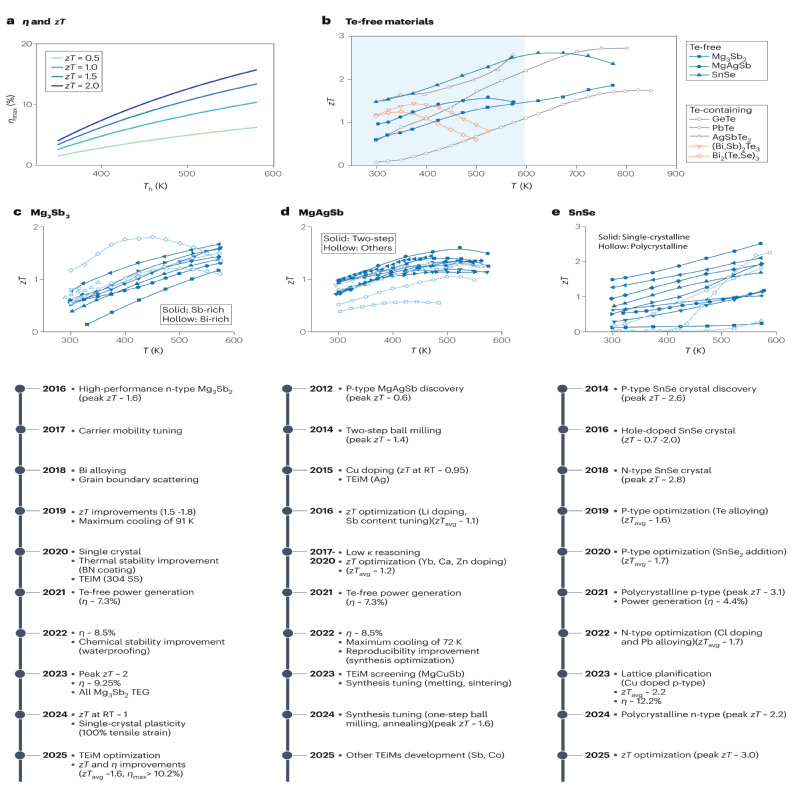
Thethermoelectric performance and development history of Mg3(Sb, Bi)2, MgAgSb, and SnSe materials. [Photo/hit.edu.cn]