

Harbin Institute of Technology Media (By Shuangyu Li, Weizhe Yuan, Text/Images)
A research team led by Professor Yi Hongliang from the School of Energy Science and Engineering, Harbin Institute of Technology (HIT), has made significant progress in the study of infrared optical properties of polar dielectric superlattices.
The study reveals the atomistic interfacial effects on the infrared dielectric response of ultrashort-period gallium nitride/aluminum nitride (GaN/AlN) superlattices. The research findings, titled Atomistic effect on infrared dielectric response of GaN/AlN superlattices, have been published in Applied Physics Reviews.
Polar dielectric materials can support phonon polaritons and hold great promise for applications in infrared nanophotonics and thermal radiation control. However, conventional approaches to infrared optical modulation mainly rely on the optical phonon properties of bulk materials, which limits the tunability of infrared spectra. Superlattices composed of atomically thin alternating layers provide a new platform for tailoring infrared responses. When the structural period is reduced to the nanometer or atomic scale, atomistic interfacial effects can significantly modify infrared optical properties, making it difficult for traditional bulk-material approximations and effective medium theories to accurately describe their physical behavior.
To address this challenge, Professor Yi’s team developed a Green-Kubo framework based on machine-learning molecular dynamics with dynamic charges. Starting from ionic dipole moment fluctuations, the method directly calculates the infrared dielectric function and infrared reflectance of ultrashort-period superlattices, establishing a quantitative link between atomic structure and infrared optical response.
The results show that, after taking interfacial atomic mixing into account, the proposed method can explain experimentally measured infrared dielectric functions and reflectance spectra of ultrashort-period GaN/AlN superlattices. Unlike classical lattice-dynamics theory within the perturbation framework, this method not only accurately predicts optical phonon frequencies, but also naturally incorporates the effects of phonon anharmonicity and interfacial atomic mixing on phonon linewidths and infrared optical responses. It therefore enables direct prediction of infrared optical properties in complex interfacial systems.
The team further investigated the effects of composition ratio and superlattice period on the infrared optical properties of GaN/AlN superlattices. With varying composition, the infrared-active phonon frequencies exhibit continuous tunability. As the superlattice period increases, the contribution of interfacial phonon modes to the infrared dielectric response gradually weakens, and the infrared response of the system progressively approaches the characteristics of bulk materials.
This work reveals the physical mechanism of infrared responses in polar dielectric superlattices from an atomistic perspective and provides new insights for the design of infrared nanophotonic devices and thermal radiation control materials.
HIT is the sole corresponding unit of the paper. Doctoral student Yuan Weizhe from the School of Energy Science and Engineering is the first author. Professor Guo Yangyu and Professor Yi are the corresponding authors.
Paper link: https://doi.org/10.1063/5.0316648
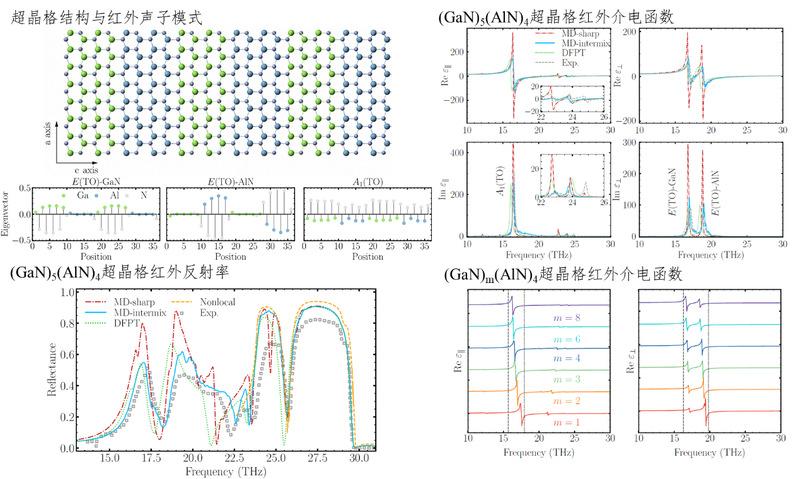
Atomistic Control of Infrared Dielectric Response in GaN/AlN Superlattices. [Photo/hit.edu.cn]