

HIT Media (Texts by Kan Simiao, He Huiping, Chen Xi; Photos by He Huiping, Chen Xi)
A research group led by Harbin Institute of Technology (HIT) Professor Chen Xi at the HIT Center for Life Sciences (HCLS) has recently made important progress in the field of targeted protein degradation(TPD), aiming to address so-called undruggable proteins.
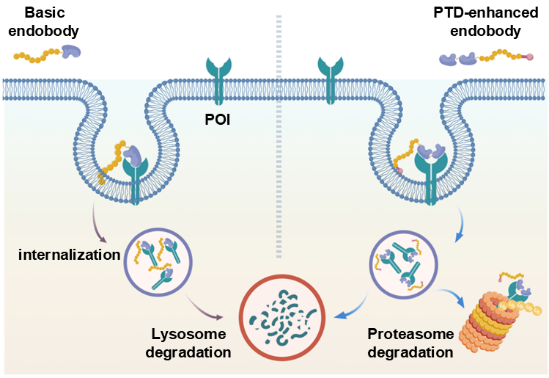
They developed a membrane and extracellular protein degradation strategy termed Endobody which consists of genetically encoded nanobody – cell-penetrating peptide (CPP) chimeras. Endobody can selectively degrade undruggable membrane proteins and extracellular proteins without relying on particular endocytic receptors.
The findings were published in Advanced Science under the title Endobody: Genetically Encodable Nanobody‑CPP Chimeras for Degradation of Membrane and Extracellular Proteins.
Membrane proteins play critical roles in cell signaling and immune responses, accounting for over 60 percent of drug targets. Secreted proteins are also important targets for disease intervention.
However, traditional drugs mostly act as "occupancy" inhibitors that merely block protein activity, failing to eliminate pathogenic proteins completely. Moreover, many disease‑associated proteins lack defined binding pockets and are classified as undruggable targets.
In recent years, degradation strategies such as lysosome‑targeting chimeras (LYTACs) have emerged, but they rely on specific endocytic receptors and are structurally complex, which limits their broad application.
To address these bottlenecks, the group designed Endobody, which is genetically encodable, easy to prepare, and potentially of low immunogenicity risk.
Endobody consists only of a nanobody fused with a CPP. Thus, the nanobody recognizes the target, while the CPP enables the target protein to be internalized into the cell and subsequently degraded in the lysosomes independent of particular membrane receptors.
The research group systematically evaluated three types of CPPs, including cationic, amphipathic, and hydrophobic, and found the cationic nonaarginine (R9) exhibited the best internalization efficiency and degradation potency. Hence, R9 was identified as the optimal CPP for designing Endobodies.
The study achieved the efficient degradation of tumor-associated membrane proteins includingthe epidermal growth factor receptor (EGFR), programmed cell death protein 1 (PD‑L1), and the human epidermal growth factor receptor 2 (HER2), demonstrating the universal applicability and the modularity of the Endobody.
More importantly, the Endobody can also degrade extracellularly secreted proteins. Taking the ovarian cancer biomarker human epididymis protein 4 (HE4) as an example, this glycoprotein lacks small‑molecule binding pockets and is widely recognized as an "undruggable" target.
The HE4‑targeting Endobody successfully mediated its endocytosis and degradation from serum, effectively inhibiting ovarian cancer cell proliferation and migration.
This degradation system can be further elaborated on. For example, the group designed a bispecific Endobody that achieved, probably for the first time, the simultaneous degradation of extracellular HE4 and membrane EGFR, providing a new route for synergistic therapy via multitarget degradation.
To further enhance the degradation potency, the group appended a proteasome‑targeting domain (PTD) to the C-terminus of Endobody, enabling the elimination of endosome escapees to boost the degradation.
For example, the PTD-appended Endobody, EER9P1 efficiently degraded EGFR at a lowered concentration of 100 nM, utilizing both lysosomal and proteasomal degradation pathways.
In an A549 lung cancer mouse model, EER9P1 significantly suppressed tumor growth without any obvious adverse effects on body weight or major organs, demonstrating good selectivity and a high level of safety.
HIT serves as the corresponding affiliation of the paper. Professor Chen from the HIT Center for Life Sciences is the independent corresponding author. Doctoral students Zhou Chengjian and He Huiping are co‑first authors. Research Assistant Xia Simin participated in some of the work.
This research was supported by funding from HIT, Overseas Outstanding Young Talents Program of China, the National Natural Science Foundation of China, and the Natural Science Foundation of Heilongjiang province.