

HIT Media (Texts by Kan Simiao, Lin Zhiying; Photos by Lin Zhiying)
A research team led by Harbin Institute of Technology (HIT) Professor Huang Zhiwei from the School of Life Sciences and Technology and HIT Center for Life Sciences (HCLS) has made strides in uncovering the regulatory mechanisms of the bacterial retron Ec78 antiphage defense system.
The team's findings were published in Proceedings of the National Academy of Sciences of the United States of America (PNAS) under the title Dual-inhibitory mechanism of the bacterial retron Ec78 antiphage defense system.
Through biochemical and structural biological analyses, the study reveals that the binding of nucleotides such as ATP and ADP induces oligomerization of the PtuAB effector complex, allosterically modulating its nuclease activity. This study identifies a novel regulatory strategy through which the retron Ec78 system precisely controls effector protein activity to enable rapid responses to phage infection.
Retrons are prokaryotic immune modules that protect bacteria from phage infection through abortive infection. The retron Ec78 system accomplishes this defense via a two-component effector protein PtuAB, which consists of an ATP hydrolase (ATPase) and an HNH nuclease. Recent studies have shown that upon phage invasion, the Ec78 system releases the PtuAB effector complex, which then specifically degrades host tRNA and triggers the death of infected cells to protect the bacterial population. However, the regulatory mechanisms controlling PtuAB activity, particularly the role of its ATPase domain in modulating effector function, remain largely unknown.
To elucidate the biochemical mechanism by which the retron Ec78 system resists phages, the team first established that the PtuAB effector complex functions as a "toxin" that specifically cleaves host tRNATyr, while the RT-msDNA component acts as an "antitoxin" that counteracts PtuAB-mediated toxicity. Further biochemical analyses revealed that ATP and ADP bind to the nucleotide-binding domain (NBD) of PtuA, inducing the PtuAB complex to assemble into an inhibitory tetramer and thereby suppressing its nuclease activity. In parallel, the RT-msDNA antitoxin stabilizes this inhibited oligomeric state upon binding to PtuAB and concurrently stimulates ATP hydrolysis, accelerating the release of ATP and ADP molecules to enable rapid effector activation (Figure 1).
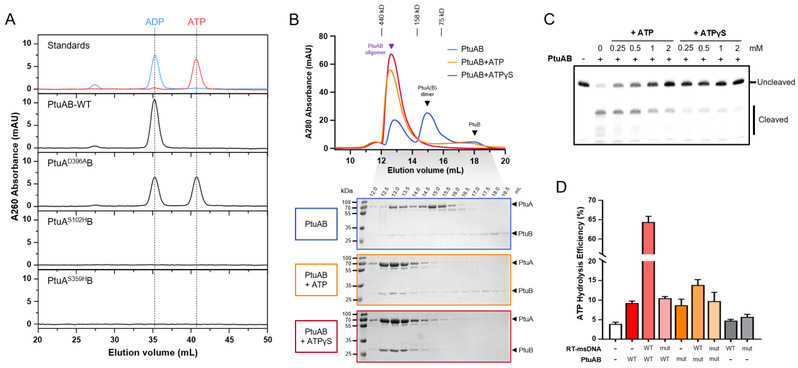
ATP binding induces the formation of a PtuAB inhibitory tetramer. [Photo/hit.edu.cn]
The team determined the cryo-EM structure of the retron Ec78 complex, revealing a stable assembly formed by RT-msDNA, PtuA, and PtuB at a 1:4:2 stoichiometric ratio. Notably, nucleotide molecules bind asymmetrically to the NBD of PtuA: PtuAI accommodates two ATP molecules, whereas PtuAII binds only one ADP molecule (Figure 2). Further structural analysis showed that the release of ATP/ADP triggers conformational changes in the PtuA NBD, including a downward displacement of a key β-loop-β (βLβ) motif and the opening of the nucleotide-binding pocket, which together destabilize the tetramer interface. Strikingly, the same conformational rearrangements were observed in the cryo-EM structure of the dissociated PtuAB effector complex. Combined structural and biochemical analyses further demonstrated that the downward shift of the βLβ motif weakens the interaction between PtuA and PtuB, allosterically modulating PtuB nuclease activity.
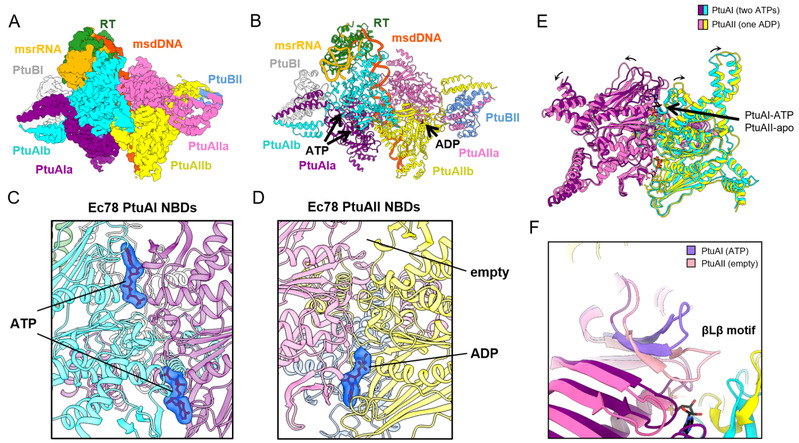
Cryo-EM structure of the retron Ec78 complex and NBD conformational changes. [Photo/hit.edu.cn]
In summary, this study establishes a dual-inhibition model for the retron Ec78 system, in which ATP/ADP-driven tetramerization and the RT-msDNA complex cooperatively maintain PtuAB in a self-inhibited state. The release of nucleotides, coupled with the dissociation of RT-msDNA, destabilizes the tetramer and triggers PtuB-mediated tRNA cleavage through an allosteric mechanism centered on the βLβ motif (Figure 3). Together, these findings illuminate the sophisticated regulatory architecture of the retron Ec78 system and provide deeper insights into the dynamic principles that govern pathogen-host interactions.
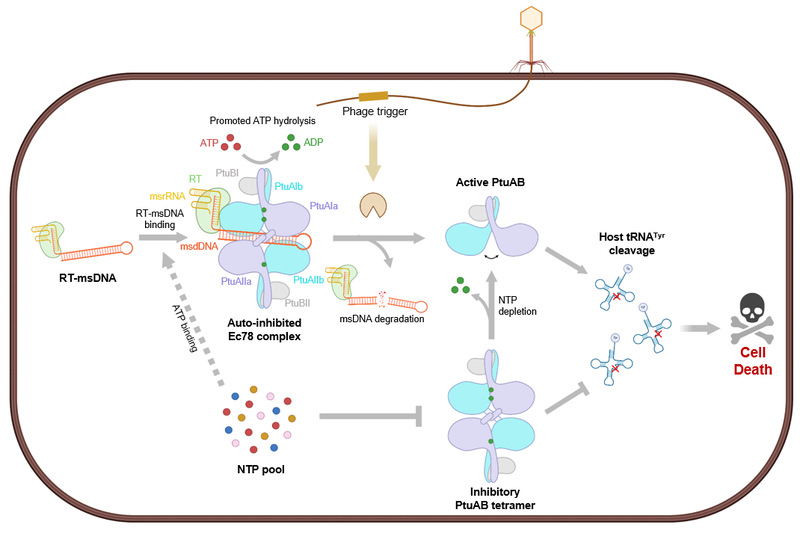
A model for the antiphage mechanism of the retron Ec78 system. [Photo/hit.edu.cn]
Professor Huang is the corresponding author, with Lin Zhiying, Guo Minghui, Lu Zebin, and Zhu Yuwei as the co-first authors. This project was supported by the National Natural Science Foundation of China, the Heilongjiang Provincial Key R&D Program, and the New Cornerstone Science Foundation.