

The 2026 Mobile World Capital (MWCapital) Awards ceremony was recently held in Barcelona, Spain.
The project RCare (an AI-enabled millimeter-wave radar vital-signs monitoring system that achieves clinical-grade, contactless monitoring of vital signs, including heart rate, respiratory rate, blood pressure, and electrocardiogram) – developed by the team of Professor Zhao Bin and Associate Researcher Li Hongzhi from Harbin Institute of Technology (HIT) – was selected among the top 17 finalists in this global science and technology innovation competition and won the championship in the Academic and Research Center category. Notably, it was the only project from Asia among the six winners.
The MWCapital Awards are jointly organized and hosted by the Global System for Mobile Communications Association (GSMA) Foundry, B Lab Spain, and Spain's Ministry for Digital Transformation and Public Service. The awards aim to recognize outstanding technology projects that drive digital transformation and promote sustainable development and positive social impact.
This event received a total of 298 project entries from 62 countries, of which 17 finalist projects were selected for their innovation, scalability, and contribution to the United Nations Sustainable Development Goals (SDGs). After a thorough evaluation, the jury selected six winning projects across various award categories, recognizing these innovative initiatives that leverage advanced technology to tackle global social and environmental issues.
All MWCapital Awards winners will gain international exposure and the opportunity to participate in collaborative projects within the global innovation ecosystem. The selected projects will also be invited to showcase their solutions at the next MWC Barcelona, providing greater exposure and opportunities to form strategic partnerships.
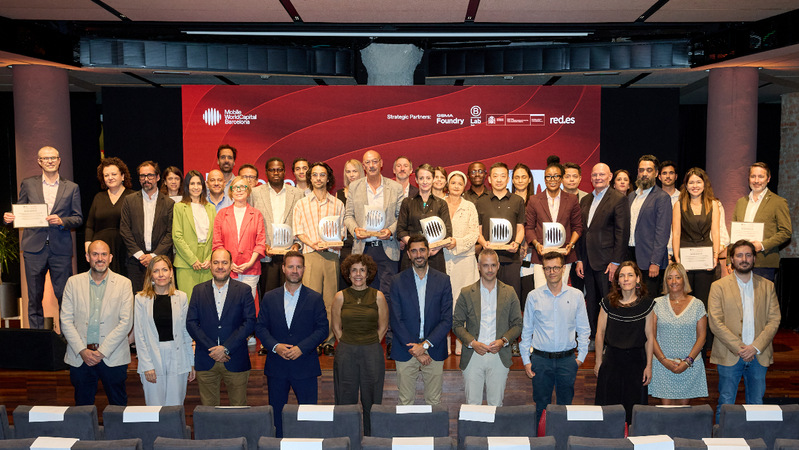 Participants pose for a group photo at the award ceremony. [Photo/hit.edu.cn]
 Associate Researcher Li Hongzhi and master's student Ayukocha Gandhi Bessemntoh Ayuknso attend the award ceremony. [Photo/hit.edu.cn]