

The Harbin satellite, also known as Bayi-04, was developed by Harbin Institute of Technology (HIT) and led by HIT Affiliated Middle School. It was launched from the Taiyuan Satellite Launch Center aboard a Long March 6C carrier rocket on Aug 25.
The satellite entered orbit with its solar panels deployed normally, marking the complete success of the launch mission.
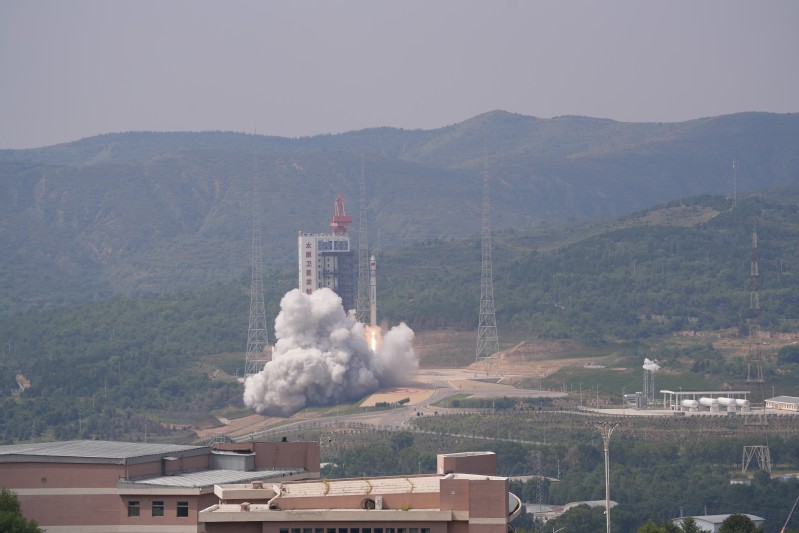
The launch site of Bayi-04. [Photo/hit.edu.cn]
The development of Bayi-04 is aimed at promoting aerospace science among young people in Harbin. The project is launched by the China Aerospace Science and Technology International Exchange Center.
Bayi-04 is an 18.7 kilogram-class satellite which carries multiple science payloads, including a science display screen, high-definition camera, micro camera, and polarization camera. Going forward, the satellite will carry out a series of space science experiments for middle school students, including space photography, surveillance camera imaging, and polarization observation.
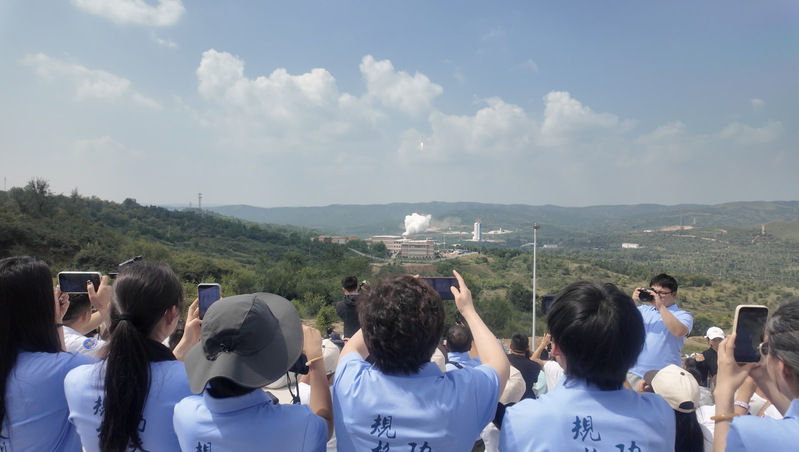 Students participating in satellite production observe the satellite launch. [Photo/hit.edu.cn]
HIT Affiliated Middle School led the project and promoted it in partnership with 77 primary and secondary schools in the Harbin Aerospace Innovation Talent Training Alliance. The development team consists of teachers and students from the HIT Lilac Student Micro-Nano Satellite Team and the Bayi-04 Middle School Student Experiment Team.
The project involves collaboration between primary and secondary school students and the HIT satellite R&D team, with full participation in payload design, equipment debugging, in-orbit application, and other stages. The university team is composed of young students, with members including undergraduate, master's, and doctoral students, as well as young teachers.
To honor and commemorate the enthusiasm of young students, the team has engraved the names of the main middle school team members who participated in the satellite's development, as well as all undergraduate students admitted to HIT in 2025, onto the satellite structure.
Editor: Yang Wenyu