

A research team led by Professor Chen Zuhuang from the School of Materials Science and Engineering, Frontier Faculty, Harbin Institute of Technology (HIT) Shenzhen campus, has developed a new approach to energy storage at cryogenic temperatures.
The team proposed a new cryogenic energy storage strategy based on dipole glass, that could help overcome the sharp decline in performance experienced by conventional energy storage devices at ultralow temperatures. The research results were published in Nature Nanotechnology entitled Cryogenic Energy Storage Enabled by Dipole Glass with Unit-cell-level Polar Disorder.
An accompanying commentary in the journal, titled Dipole glasses unlock the cryogenic frontier of energy storage, said the proof-of-concept demonstrated in the study could provide a blueprint for a broader range of cryogenic dielectric devices.
In frontier fields such as deep-space exploration, quantum computing, and deep-sea and polar exploration, electronic devices must operate stably at cryogenic temperatures down to 4 kelvins (about −269 C). However, reduced ionic mobility and sluggish electrochemical reaction kinetics cause conventional energy storage devices such as chemical batteries to perform significantly worse at low temperatures, limiting their use in technologies designed for extreme environments.
In contrast, dielectric capacitors have intrinsic advantages at low temperatures because they store energy through physical polarization. Nevertheless, most state-of-the-art dielectric energy storage materials are based on relaxor ferroelectrics. Although their room-temperature energy storage efficiency can exceed 80 percent, the polar nanoregions that play a key role inside them freeze at low temperatures and form long-range ferroelectric order, causing polarization hysteresis loss to increase and energy storage efficiency to drop precipitously. This inherent limitation restricts most relaxor ferroelectrics to operating temperatures above 200 K, creating a critical technical gap.
The research team introduced nonpolar SrZrO3 into the antiferroelectric material PbZrO3 and constructed a dipole glass state near the antiferroelectric–paraelectric phase boundary (composition Pb0.6Sr0.4ZrO3).
In this system, the antiferroelectric component provides enhanced antipolar coupling at low temperatures and works together with chemical disorder to prevent dipoles from forming long-range order. At the same time, the random distribution introduced by the paraelectric component confines dipole-dipole interactions to the unit-cell scale and flattens the local free-energy barriers, thereby suppressing polarization hysteresis loss while maintaining high polarizability.
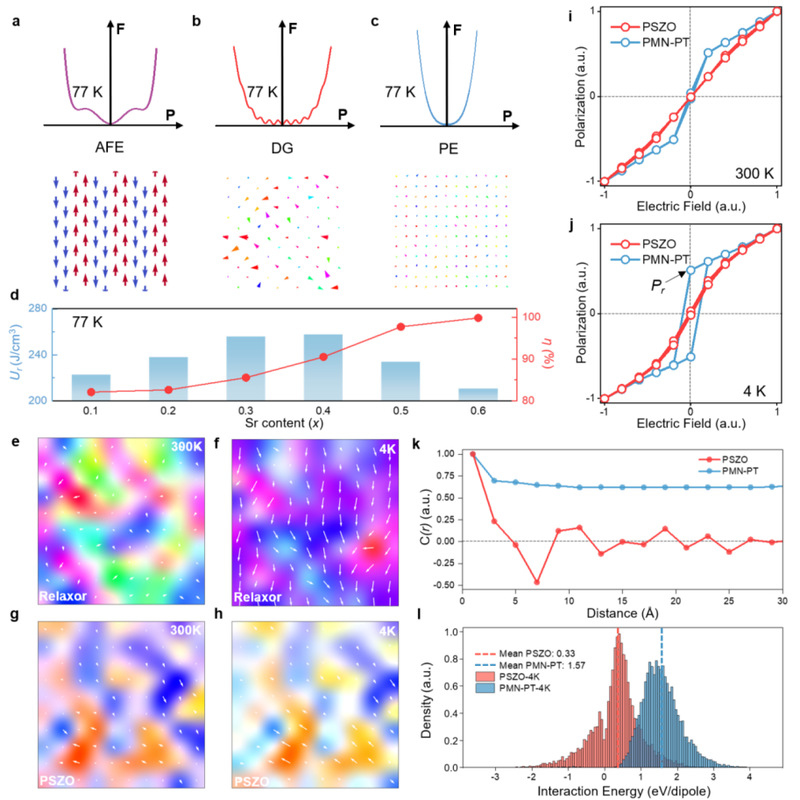
Theoretical design and molecular dynamics simulations of dipole glass.[Photo/hit.edu.cn]
To verify this design concept, the team collaborated with Westlake University, the Institute of Physics, Chinese Academy of Sciences (CAS), The Hong Kong Polytechnic University, and other institutions to carry out systematic theoretical simulations and experimental characterizations.
Molecular dynamics simulations showed that in PMN-PT(Pb(Mg1/3Nb2/3)O3–PbTiO3), a typical relaxor ferroelectric, the originally disordered polar nanoregions at 300 K freeze into a single-domain ferroelectric state after cooling to 4 K, leading to a sharp increase in remanent polarization and a substantial increase in hysteresis loss. In contrast, even after electric-field poling at 4 K, Pb0.6Sr0.4ZrO3 still maintained a randomly oriented local dipole distribution. Its dipole–dipole spatial correlation function decayed to zero within 10 Å (about two to three unit cells), indicating the absence of any long-range polar order.
The team further used atomic-resolution cryogenic electron ptychography to observe the A-site cation displacement distribution in Pb0.6Sr0.4ZrO3 films at 95 K. The results showed that even at low temperatures, dipole orientations remained random, and the displacement magnitude distribution exhibited Gaussian characteristics (standard deviation about 2.5 pm), almost consistent with the statistical distribution at 300 K. This direct atomic-scale evidence confirmed the intrinsic stability of the dipole glass state at low temperatures.
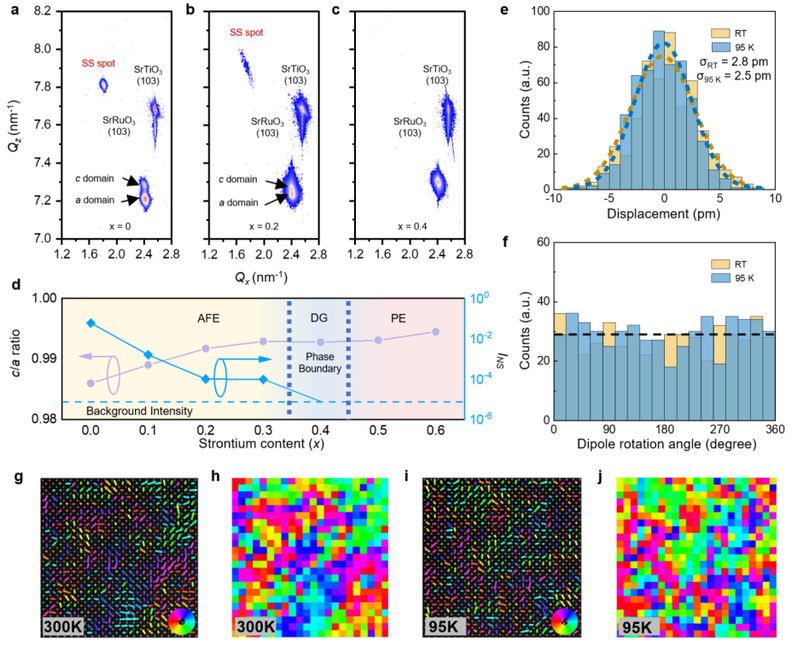 Characterization of structural disorder in dipole glass.[Photo/hit.edu.cn]
Based on the above material design, the research team prepared high-quality Pb0.6Sr0.4ZrO3 epitaxial films. The material maintained an energy storage efficiency above 88 percent over a wide temperature range from 4 K to 300 K and achieved a high energy storage density of 211 J/cm3 at 77 K (liquid nitrogen temperature). It also showed almost no performance degradation after 108 charge–discharge cycles, with charge-discharge speeds on the microsecond scale.
Compared with commercial biaxially oriented polypropylene (BOPP) films, multilayer ceramic capacitors (MLCCs), and reported dielectric films, this dipole glass system achieved highly reliable, high-density energy storage operation at a liquid helium temperature (4 K) for the first time, greatly extending the operating temperature range of cryogenic energy storage from the liquid nitrogen range (77 K) to the liquid helium range.
This work provides a new solution for powering electronic devices in extreme environments. By manipulating polar disorder at the unit-cell scale, this strategy is expected to open up broader opportunities for the design of dielectric functional materials.
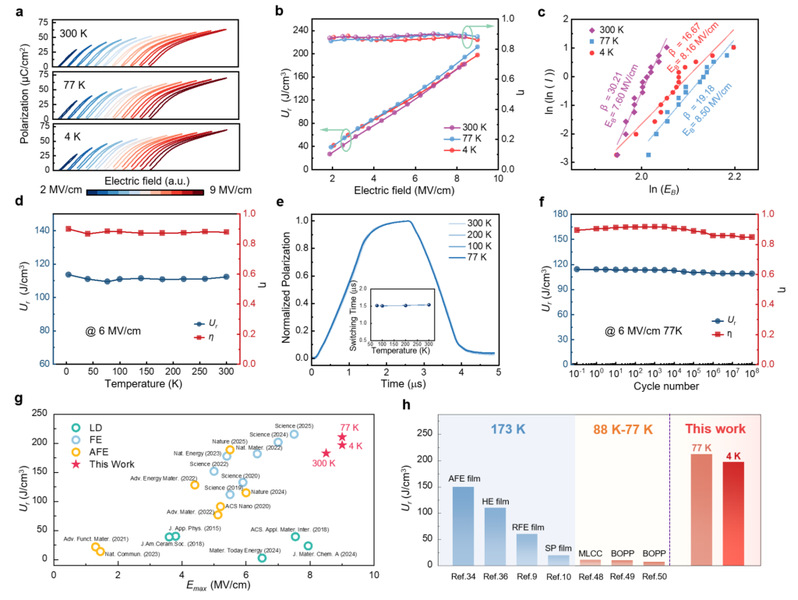 Characterization of cryogenic energy storage performance of dipole glass.[Photo/hit.edu.cn]
HIT Shenzhen campus is the first corresponding affiliation.
Associate Professor Si Yangyang of HIT Shenzhen campus; Doctoral student Li Denan of Westlake University; Master's student Li Yijie of HIT Shenzhen campus; and Chen Changsheng, a joint doctoral student of The Hong Kong Polytechnic University and CAS's Institute of Physics, are co-first authors.
Professor Chen Zuhuang of HIT Shenzhen campus, Professor Liu Shi of Westlake University, Professor Chen Zhen of the Institute of Physics, CAS, Professor Pan Hao of Peking University Shenzhen Graduate School, and Professor Li Fei of Xi'an Jiaotong University are co-corresponding authors.
Professor Xu Chengyan and Professor Qin Jingkai of HIT Shenzhen campus, Professor Wang Junling of City University of Hong Kong, Professor Sujit Das of Indian Institute of Science, and Professor Jieun Kim of South Korea Advanced Institute of Science and Technology also contributed to this work.
The research was supported by the National Natural Science Foundation of China, the Guangdong Basic and Applied Basic Research Foundation, the Shenzhen Young Outstanding Science and Technology Talent Cultivation Program, and HIT's 0-1 Original Exploration Program.