

HIT Media (Reported by Li Shuangyu, Wang Zhenbo / Photographed by Wang Zhenbo)
Professor Wang Zhenbo's research team from the School of Chemistry and Chemical Engineering at Harbin Institute of Technology (HIT) has made significant progress in oxygen reduction electrocatalysts.
The team proposed an axial sulfur coordination strategy to regulate the charge symmetry of dual-atom active sites and constructed an axially sulfur-coordinated Co-Zn dual-atom catalyst, enabling efficient and stable oxygen reduction reactions across a wide pH range.
The research findings, titled Breaking Charge Symmetry in Co-Zn Dual-Atom Catalyst with Axial Sulfur Coordination for Efficient Oxygen Reduction Reaction, have been accepted for publication in Angewandte Chemie International Edition. This achievement provides new insights into the precise regulation of the local electronic structures of dual-atom catalysts and the rational design of high-performance oxygen reduction electrocatalysts.
Addressing the scientific challenge that the relatively symmetric local charge distribution of conventional dual-atom catalysts can hinder O-O bond polarization and cleavage during the oxygen reduction reaction, Professor Wang's team screened various sulfur coordination configurations and constructed an axially sulfur-coordinated Co-Zn dual-atom catalyst (Co-Zn@SNC) through a molecular-cage-confined coordination strategy.
The results demonstrate that axial S coordination modulates the orbital and electronic structures of the Co active center and, in synergy with the neighboring Zn site, breaks the charge symmetry of the local Co-N₄ coordination environment.
This asymmetric electronic configuration optimizes the adsorption strength of the key *OOH intermediate, facilitates O-O bond activation, and lowers the reaction energy barrier. Such electronic modulation also enhances the resistance of the active sites to protonation and metal leaching, thereby improving the structural stability of the catalyst.
Experimental results demonstrate that Co-Zn@SNC exhibits excellent catalytic activity and stability in alkaline, neutral, and acidic electrolytes, while also delivering favorable energy conversion performance and operational stability in zinc-air batteries and microbial fuel cells.
This work reveals, at the atomic scale, the regulatory mechanism of axial coordination and bimetallic synergy in the oxygen reduction reaction, offering a new design strategy for constructing asymmetric dual-atom active sites and developing high-performance electrocatalysts for energy conversion.
HIT is the first corresponding institution of the paper. Doctoral candidate Zou Jixiang from HIT's School of Chemistry and Chemical Engineering and postdoctoral fellow Shen Lixiao from Shenzhen University are co-first authors. Professor Wang, Professor Zhao Lei, Associate Professor Yan Mei, and Professor Guo Chongshen are co-corresponding authors of the paper.
This research was supported by the National Key Research and Development Program of China, the National Natural Science Foundation of China, the Shandong Key Research and Development Program, and the Heilongjiang Provincial Natural Science Foundation, among other projects.
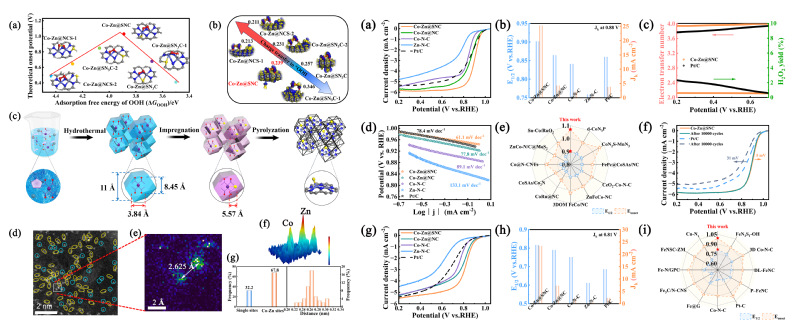 Charge-Asymmetric Co-Zn Dual-Atom Catalysts Constructed via an Axial Sulfur Coordination Strategy. [Photo/hit.edu.cn]