

A research team led by Professor Liu Yingxiang from the State Key Laboratory of Robotics and Systems at Harbin Institute of Technology (HIT) has systematically reviewed recent advances in high-performance piezoelectric actuation technologies and their applications in extreme manufacturing.
They proposed an evaluation framework with five key performance metrics: scale, speed, force, degrees of freedom(DOF), and accuracy. They further elucidated performance regulation mechanisms and multidimensional optimization strategies. From the perspective of actuation principles, they analyzed the bottlenecks that constrain performance enhancement under different operating modes. The study provides theoretical and technical guidance for the design of high-performance piezoelectric actuators.
The findings were published in the International Journal of Extreme Manufacturing under the title Review on high-performance piezoelectric actuators for extreme manufacturing: strategies for scale, speed, force, degrees of freedom, and accuracy.
Piezoelectric actuation is an emerging technology that converts electrical energy into mechanical energy through the inverse piezoelectric effect. It offers several distinctive advantages, including nanoscale positioning accuracy, millisecond-level response, high power density, and immunity to electromagnetic interference.
Consequently, piezoelectric actuation technology is essential for reliable operation of manufacturing equipment under extreme dimensional scales, precision requirements, and operating conditions. As advanced equipment evolves toward cross-scale machining, ultra-precision forming and operation in extreme environments, the improvement of individual performance and the coordinated optimization of multiple performance metrics have become critical technologies for advancing high-end manufacturing equipment.
The work systematically reviews the evolution of high-performance piezoelectric actuation technologies for extreme manufacturing and identifies evaluation strategies covering five core performance metrics. In terms of scale, including size, weight, and stroke, it summarizes strategies for miniaturization and lightweighting based on the development of high-performance piezoelectric materials, optimization of actuator structures, and system integration. It also examines cross-scale actuation methods spanning from nanoscale precision positioning to centimeter-scale long-stroke motion. Regarding speed, including speed range and smoothness, the work reviews approaches for enhancing working bandwidth and step size through actuation mechanism optimization and waveform matching, as well as methods for smooth actuation at ultralow speeds.
For force-related performance, including thrust, torque, and position-holding capability, it discusses enhancement mechanisms such as coordinated force-displacement design and actuation-transmission fusion. With respect to DOF, covering linear, rotary, and multi-DOF motion, the work summarizes design methods and motion-decoupling techniques ranging from single-DOF to multi-DOF actuation. In terms of accuracy under both open- and closed-loop operation, it analyzes approaches involving hysteresis nonlinearity suppression, multi-source error compensation, and high-precision closed-loop control.
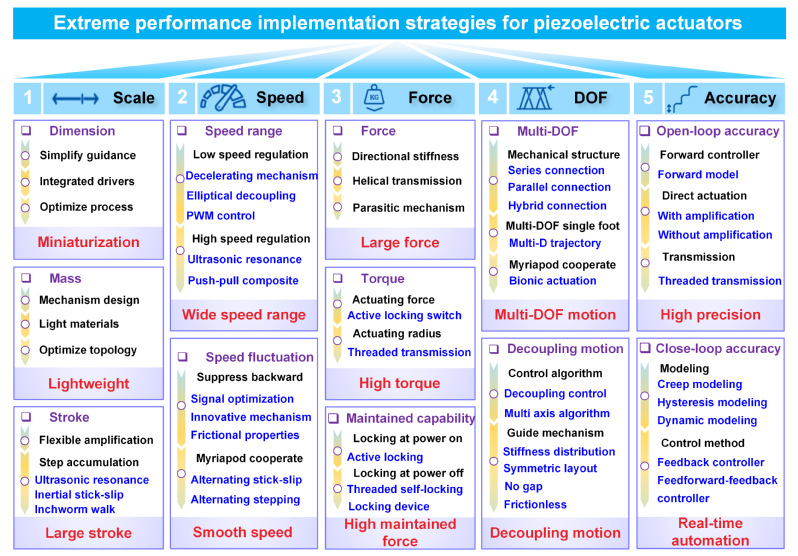 Performance evaluation strategy for piezoelectric actuation technology. [Photo/hit.edu.cn]
The work further compares the applicable conditions and limits of different technical approaches, while identifying the challenges and potential directions for future breakthroughs. Piezoelectric actuators working in a single mode typically exhibit targeted performance characteristics, rather than outstanding comprehensive performance across all evaluation metrics. For example, ultrasonic resonance offers high output force, high speed, and long travel, but its displacement resolution is limited to the sub-micrometer.
In contrast, direct actuation can achieve nanometer or even sub-nanometer displacement resolution, although its operating stroke is relatively limited. To further broaden the application of piezoelectric actuators, the work proposes a new multi-mode integrated actuation concept. Different operating modes are selected according to the required characteristics, enabling a single piezoelectric actuator to combine high precision, long travel, high output force, and high speed.
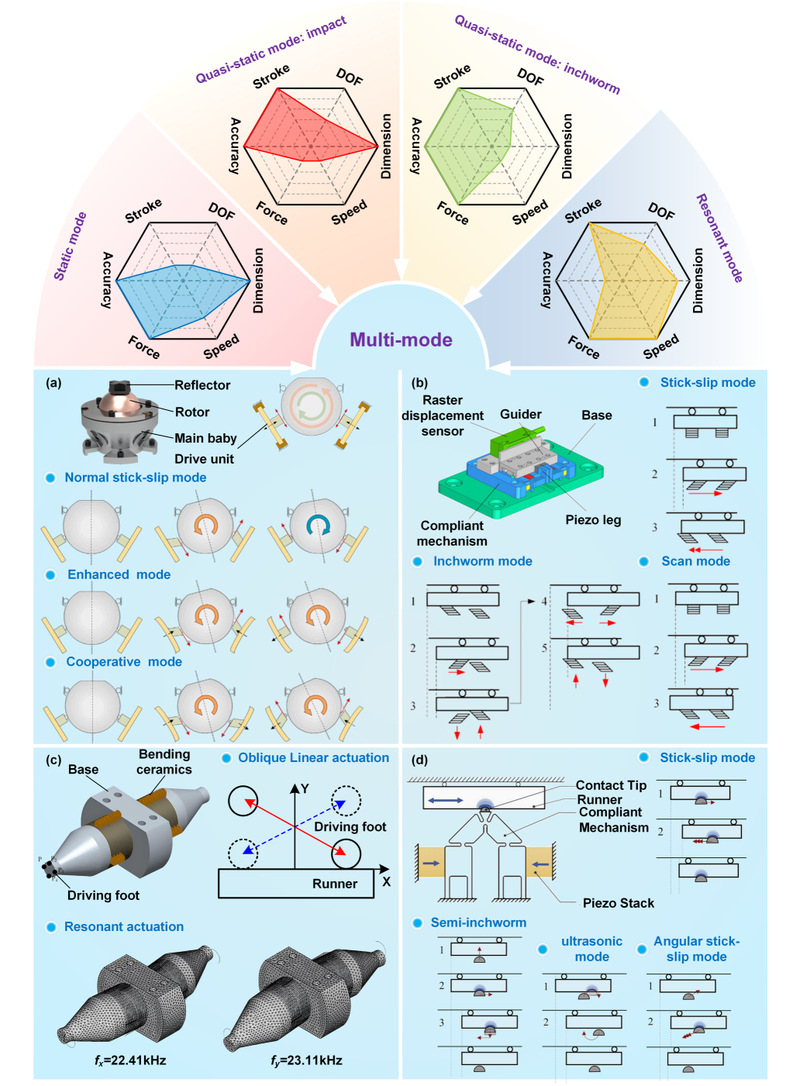
Multi-mode integrated piezoelectric actuation technology. [Photo/hit.edu.cn]
The work also outlines future research directions, including the development of high-performance piezoelectric materials, innovative configurations and guidance mechanisms, highly efficient actuation principles, adaptability to extreme environments, and intelligent control strategies. These perspectives establish a strong theoretical foundation for advancing piezoelectric actuators toward higher performance, greater multifunctionality, and improved reliability.
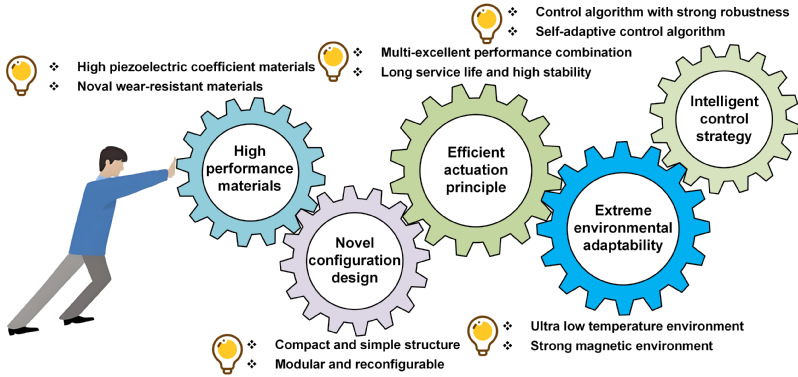
Future research directions of performance improvement strategies for piezoelectric actuation technology. [Photo/hit.edu.cn]
HIT serves as the corresponding affiliation of the paper. Professors Liu and Deng Jie of the State Key Laboratory of Robotics and Systems are the co-corresponding authors. Doctoral student Sun Jianhua and Associate Research Fellow Guan Jinghan are the co-first authors, while Associate Professor Li Jing and Associate Research Fellow Zhang Shijing are co-authors.
This work was supported by funding from the National Natural Science Foundation of China and the Fundamental Research Funds for the Central Universities.