

HIT Media (Text and Photos: Wang Chenyang, Kou Yuhe and Li Tengjie)
The eighth National Science Experiment Presentation and Performance, organized by Science and Technology Daily, was recently held.
Harbin Institute of Technology (HIT) won two grand prizes and one third prize, as well as one Best Performance Award and one Best Popularity Award.
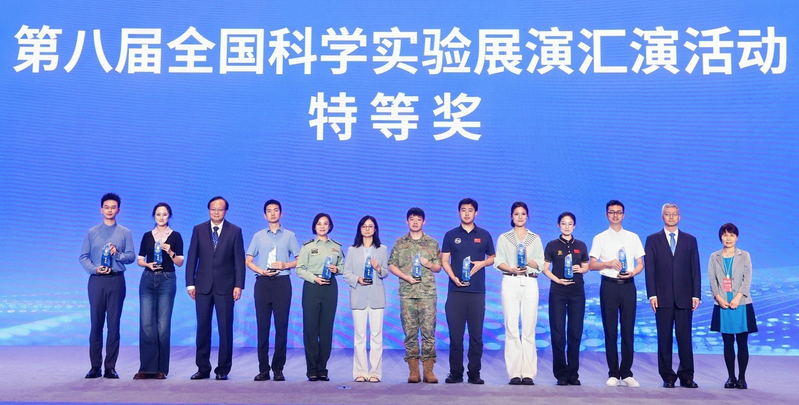 The award ceremony takes place. [Photo/hit.edu.cn]
The entry, titled "A Bag to Bring Lunar Soil Safely Home", was created by a team of faculty members and students from HIT's School of Chemistry and Chemical Engineering. It turned a research breakthrough into three easy-to-understand experiments, introducing a flexible coring bag developed by CAE Academician Huang Yudong's team to package samples that preserve the sequence of layers in lunar soil profiles. By using a focused, accessible example to explain a larger scientific achievement, the presentation made the highly specialized techniques used to collect and package lunar soil samples easier for the public to understand. It also showed how cutting-edge research can strengthen public science communication.
Li Tengjie, a faculty adviser to the school's "Wings of Love" Youth Volunteer Association, coached a team of five students for the competition. Starting from scratch, they developed and refined the script and made the props by hand. Their entry won a top prize and the Best Performance Award.
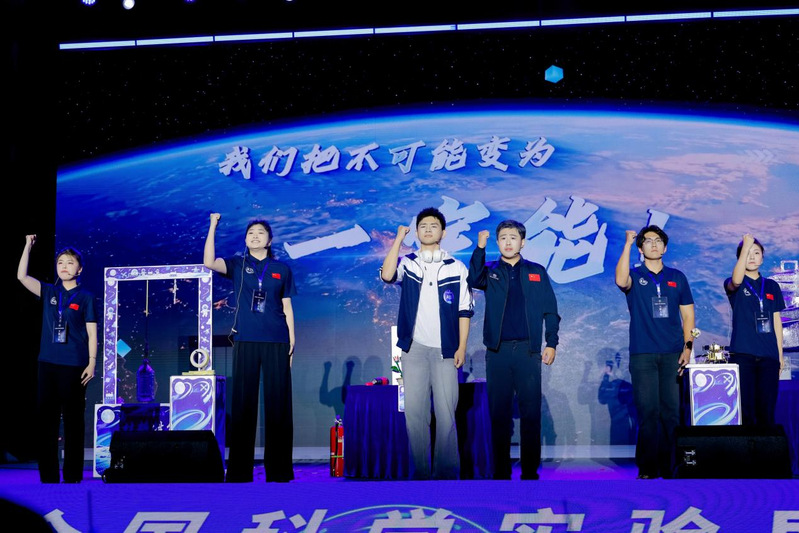
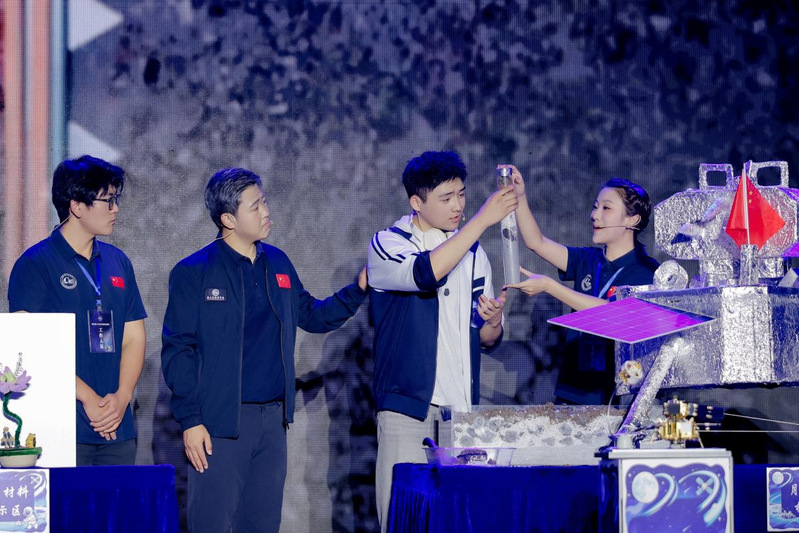
The entry titled "A Bag to Bring Lunar Soil Safely Home". [Photo/hit.edu.cn]
The entry, titled "Lunar Settlement Plan: The Challenge of Building Astronauts' Future Home on the Moon", was created by a team of faculty members and students from HIT's Party Committee Publicity Department and Media Center. In just six minutes, the team demonstrated four scientific experiments: the passive deployment of a shape-memory-alloy structure, melting lunar soil at high temperatures and drawing the molten material into fibers, magnetic-levitation transport using quantum locking, and electricity generation using a semiconductor's thermoelectric effect.
Using lunar-base construction as its setting, the presentation brought the experiments to life through a series of mission-based scenarios. It wove scientific questions about survival on the lunar surface and the use of lunar resources into the storyline, illustrating humanity's aspirations to explore deep space and establish a presence on the Moon. Kou Yuhe, the team's adviser, led a team of five student volunteers in the competition. The entry won a top prize and the Best Popularity Award.
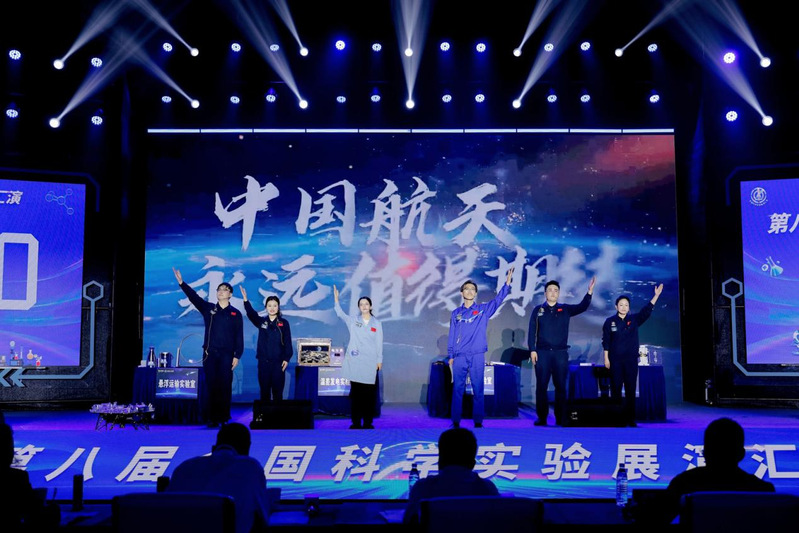
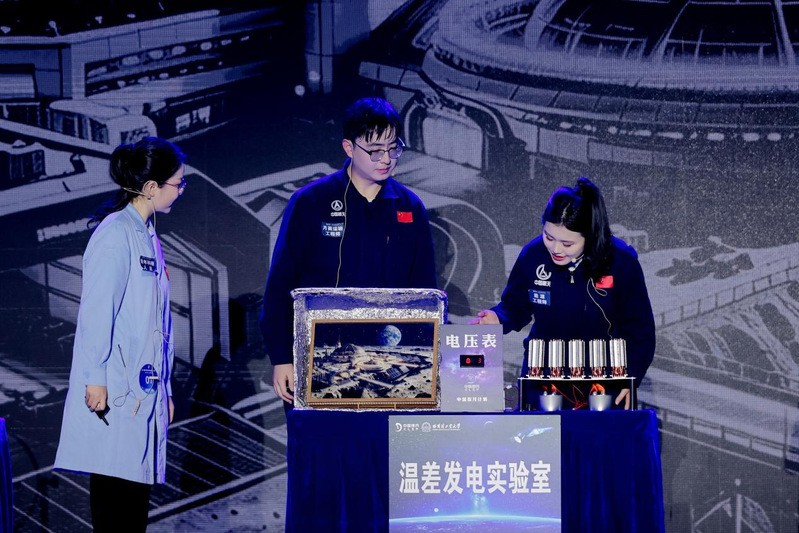 The entry titled "Lunar Settlement Plan: The Challenge of Building Astronauts' Future Home on the Moon". [Photo/hit.edu.cn]
The entry, titled "Taking Flight: Unlocking the Science Behind Rocket Launch", was created by a team of faculty members and students from HIT's Party Committee Publicity Department and Media Center. It focused on rocket recovery technology and used a science-themed stage play depicting developments over more than two decades to explain the principles of rocket propulsion and recovery. By personifying scientific concepts, the play made complex aerospace technology easier to understand through accessible science demonstrations. It also showed how science and art can be combined in creative ways. Kou Yuhe, the team's adviser, led a team of five student volunteers in the competition. The entry won third prize.
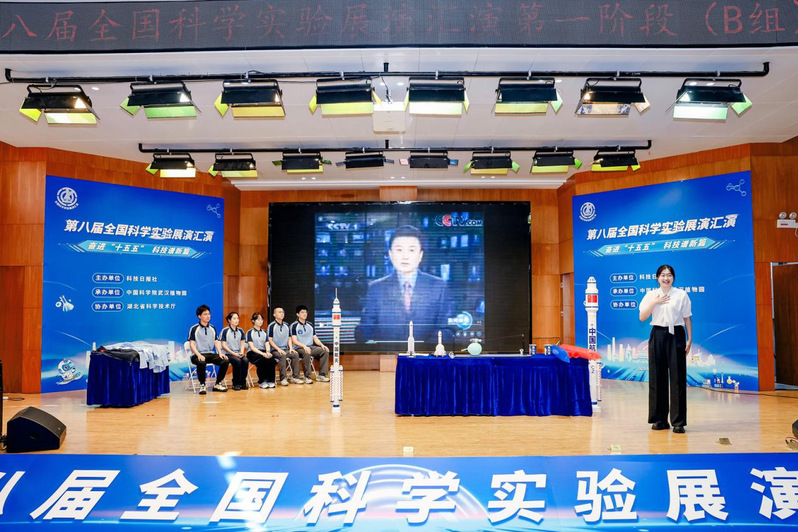 The entry titled "Taking Flight: Unlocking the Science Behind Rocket Launch". [Photo/hit.edu.cn]
With the theme "Advancing the Goals of the 15th Five-Year Plan (2026-30) and Opening a New Chapter in Science and Technology," this year's event attracted 168 teams and 755 participants from 59 organizations that recommended teams for the competition. Participation reached a record high, making this the largest event of its kind to date.
Edited by: Shang Yankai
Reviewed by: Song Ling, Li Shoubin, Yang Wenyu