

HIT Media (Text by Shuangyu Li and Pengzhen Guo; Photo by Yanlong Zhang)
The Planetary Environmental Physics Laboratory at the Space Environment Ground Simulation Facility, a major national scientific and technological infrastructure project, proposed a high-efficiency off-axis solar concentrator with large angular tolerance.
With an aperture diameter of 300 mm, the concentrator achieves an effective concentration ratio of 548 and an acceptance half-angle of ±0.5°, and reaches a peak focal temperature of 892 C in outdoor experiments. This technology provides a new high-temperature solar concentration solution for lunar base construction and in-situ resource utilization (ISRU), including lunar regolith melting. The research findings were published in the international academic journal Engineering on Oct 30.
Variations in solar elevation angle and complex terrain on the lunar surface impose stringent requirements on concentrator tracking accuracy. Although conventional off-axis dish concentrators offer high concentration ratios, their acceptance half-angles are typically below 0.2°-0.3°, meaning that even small pointing errors can cause a sharp decline in efficiency. Achieving a balance between a high concentration ratio and large angular tolerance has therefore remained a major challenge in space solar concentration technology.
To address this challenge, the team proposed a design combining a zero-occlusion triple-mirror configuration with conjugate-mirror-based aberration compensation. The system consists of an off-axis concentrator, a conjugate mirror, and a plane mirror. Through feedback-based iterative optimization of the freeform reflective surfaces, the design suppresses higher-order aberrations, including coma and spherical aberration induced by the off-axis configuration. Simulations show that the normalized total Seidel aberration index decreases from 1.00 to 0.04, while the root-mean-square (RMS) radius of the focal spot is less than 10 micrometers in the main field of view and less than 26 μm across the full field of view.
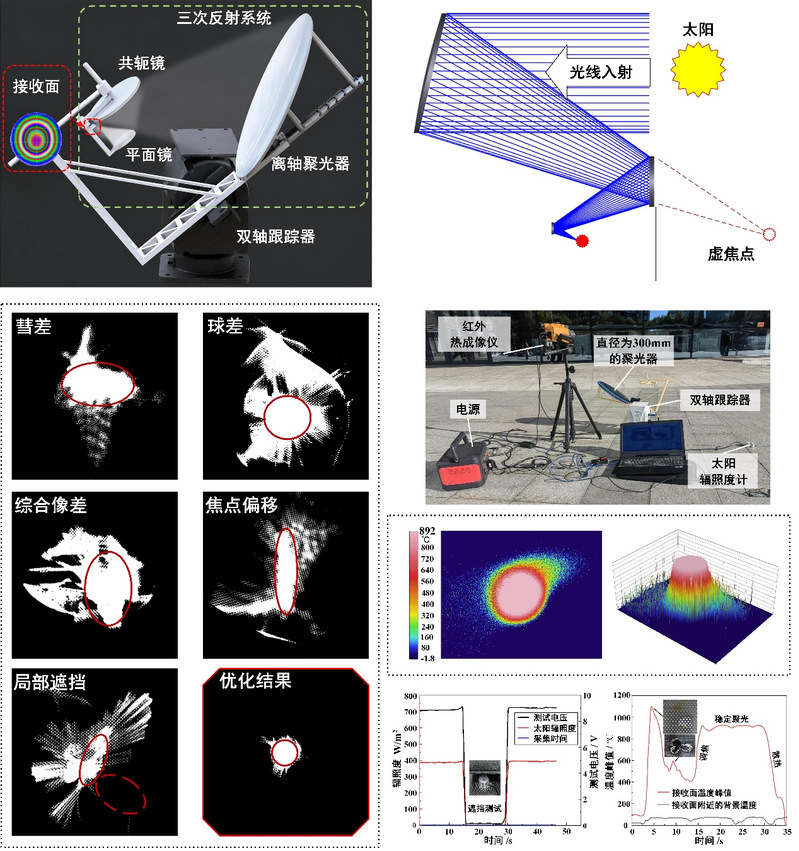
High-efficiency off-axis space solar concentrator with high tolerance for variations in the angle of incidence. [Photo/hit.edu.cn]
During experimental validation of the high-efficiency off-axis conjugate solar concentrator, the team conducted outdoor solar-concentration experiments under a solar irradiance of 390 W m⁻² at ground level and an ambient temperature of 5 C. The peak focal temperature reached 892 C, the focal temperature remained above 800 C during stable heating, and the effective concentration ratio was 548. Extrapolation to lunar solar irradiance under purely radiative heat-transfer conditions predicts a focal temperature of 1,326 C, which could meet the requirements of high-temperature processes such as melting lunar regolith to produce bricks.
According to the team, the key value of this technology lies in achieving greater tracking tolerance through aberration compensation. Compared with conventional off-axis dish concentrators, the proposed system maintains a high concentration ratio while increasing the acceptance half-angle to ±0.5°, approximately doubling its angular tolerance. This could reduce the reliance of space solar-concentration systems on precision tracking mechanisms and provide an engineering-feasible high-temperature heat-source solution for future lunar ISRU applications. The next steps will include space-environment adaptability testing, the development of a lightweight proof-of-concept prototype, and integrated testing with a lunar regolith melting system, with the aim of advancing the technology from proof-of-principle validation toward practical applications on the lunar surface.
Harbin Institute of Technology is the only institution listed as an affiliation in the paper. Zhang Yanlong, a doctoral student at the School of Mechatronics Engineering, is the first author. Guo Pengzhen, a researcher at the National Key Laboratory of Laser Spatial Information, School of Astronautics, and Li Lifang, a researcher at the State Key Laboratory of Space Environment and Material Interactions, Institute of Space Environment and Matter Science, are the co-corresponding authors.
Professors Liu Rongqiang and Guo Hongwei of the National Key Laboratory of Aerospace Mechanism, together with doctoral students Tian Mengfan, Chen Yun, Zin Min Khant, Kong Yiming, Gao Dingkun, and Li Linghao of the School of Mechatronics Engineering, also contributed to the research.