

HIT Media Center (Kan Simiao & Yuan Chengxun/text; Yuan Chengxun/photos)
Professor Yuan Chengxun from the School of Physics at Harbin Institute of Technology (HIT), in collaboration with Professor Liu Guigeng from Westlake University, has achieved important progress in the study of non-Hermitian exceptional states.
The findings were published in Nature Communications under the title Exceptional Bound States in the Continuum in a Passive Terahertz Metasurface.
The exceptional point (EP) is a special class of degeneracy in non-Hermitian systems. Its eigenvalues respond with extreme sensitivity to tiny external perturbations, making EPs highly promising for high-sensitivity sensing. However, for typical non-Hermitian EPs, radiation loss readily broadens the resonance linewidth, limiting the effective detection of weak perturbation signals. The bound state in the continuum (BIC), by contrast, is a special localized state in open systems that can suppress radiation loss.
Combining the two distinct physical mechanisms into an exceptional bound state in the continuum (EP-BIC) is expected to unite the ultrasensitive perturbation response of the EP with the radiation-suppression advantage of the BIC. How to realize an EP-BIC in a fully passive system, without external gain or fine-tuned loss, has long been a major challenge in this field.
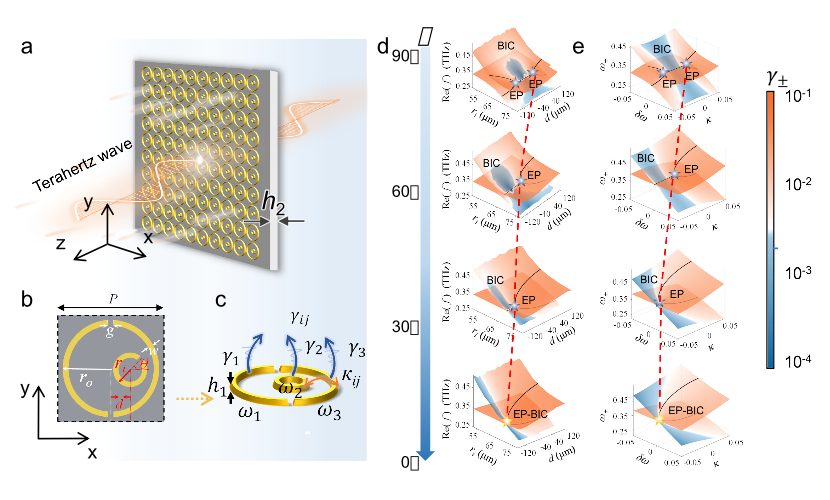
The metasurface design for realizing the exceptional bound state in the continuum. [Photo/hit.edu.cn]
To tackle this challenge, the research team refined the theoretical foundation of the EP-BIC based on the generalized Friedrich-Wintgen bound state in the continuum condition(FW-BIC), and accordingly designed a terahertz metasurface composed of two sets of metallic split-ring resonators. By tuning the coupling between the resonant modes through geometric rotation, the EP was gradually merged with the BIC to realize the EP-BIC. Using a home-built terahertz (THz) near-/far-field scanning imaging system, the team clearly observed the evolution from the EP to the EP-BIC and revealed the characteristic energy distribution of the EP-BIC in momentum space.
Furthermore, the team verified the sensing performance of the EP-BIC through water-vapor perturbation experiments, observing a distinguishable transmission-dip response. The tests show that the device achieves a maximum sensitivity of 5.32 GHz/%RH and a maximum figure of merit (FOM) of 12.87 (%RH)⁻¹. This work provides a new experimental route for constructing and manipulating non-Hermitian exceptional states in passive artificial electromagnetic systems, and offers an important reference for high-performance terahertz sensing and the design of novel electromagnetic functional devices.
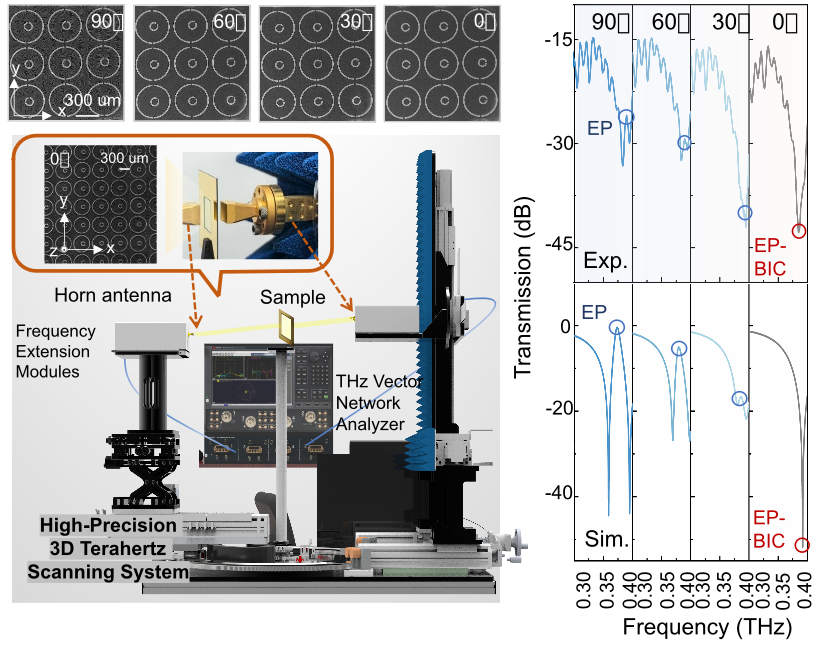
The evolution of the EP-BIC and its terahertz near-/far-field experimental characterization. [Photo/hit.edu.cn]
In recent years, Professor Yuan's team has carried out a series of studies on low-temperature plasma physics and novel artificial electromagnetic structures, making progress in plasma metamaterials, plasmonic electromagnetic responses, topological and time-varying electromagnetic manipulation, and the construction and control of non-Hermitian exceptional states. These findings have been published in leading international journals such as Communications Physics, Plasma Sources Science and Technology, Laser and Photonics Reviews, ACS Photonics, APL Photonics, Nanophotonics, and Physical Review A/B/E.
HIT is the first affiliation of the paper. Chen Chen, Liu Ziyi (doctoral students) and Li Jianfei (assistant researcher) from the School of Physics are co-first authors. Professor Yuan, Associate Professor Yao Jingfeng and Assistant Researcher Li Jianfei from the School of Physics, together with Professor Liu Guigeng from Westlake University, are co-corresponding authors. Professor Zhou Zhongxiang and Associate Professor Wang Ying from the School of Physics, and Professor Liu Hongyu from the City University of Hong Kong, China, made important contributions to the publication. Doctoral students Zhou Junhan and Jiang Yuanhang participated in the research.
This work was supported by the National Natural Science Foundation of China, the National Key Research and Development Program of China, the Young Science and Technology Talent Support Program of Heilongjiang province, the Natural Science Foundation of Heilongjiang province, and the Stable Support Program of the China Research Institute of Radiowave Propagation.