

Professor Liu Yingxiang's research team at the State Key Laboratory of Robotics and Systems has made significant progress in multidimensional ultrasonic vibration, with its findings, Six-dimensional programmable ultrasonic vibration for multimodal object manipulation, published in National Science Review, offering a new approach to developing highly flexible and multifunctional ultrasound manipulation.
Ultrasound manipulation with broad applicability demonstrates great promise in fields such as precision manufacturing and microscale manipulation. However, traditional ultrasound manipulation primarily relies on ultrasonic vibration propagating through a fluid medium to manipulate objects. Manipulation performance is limited by factors such as object size, medium, and material properties.
Although phased arrays and acoustic holography have expanded manipulation capabilities, they typically require complex transducer arrays, mechanical structures, or control algorithms, making it difficult to balance system simplicity, manipulation flexibility, and functional diversity. Therefore, exploring new methods for generating ultrasonic vibration has become a key research direction.
To address these challenges, the team proposed six-dimensional (6D) ultrasonic vibration and designed a 6D device consisting of five orthogonally arranged piezoelectric-metal composite beams. By coupling the horizontal beam's longitudinal vibration with the vertical beam's bending vibration, the team can simultaneously generate the translational vibration component along the in-plane axis and the rotational vibration component around the in-plane axis.
In contrast, the vertical beam's longitudinal vibration can independently generate the translational vibration component along the normal axis. By adjusting the phase difference between the excitation signals, the team utilized vector synthesis of the in-plane translational vibration components to equivalently generate the rotational vibration component around the normal axis. As a result, 3D translational and rotational vibration components can ultimately be generated on the vibrating surface.
The team developed a variety of programmable ultrasonic vibration fields. By using the dynamic contact and frictional coupling between the vibrating surface and the object, the team converted the surface's multidimensional vibration into directed motion of the manipulated object. As a result, the team achieved multimodal object manipulation, including arrangement, aggregation, translation, rotation, and bounce on the elastomer surface.
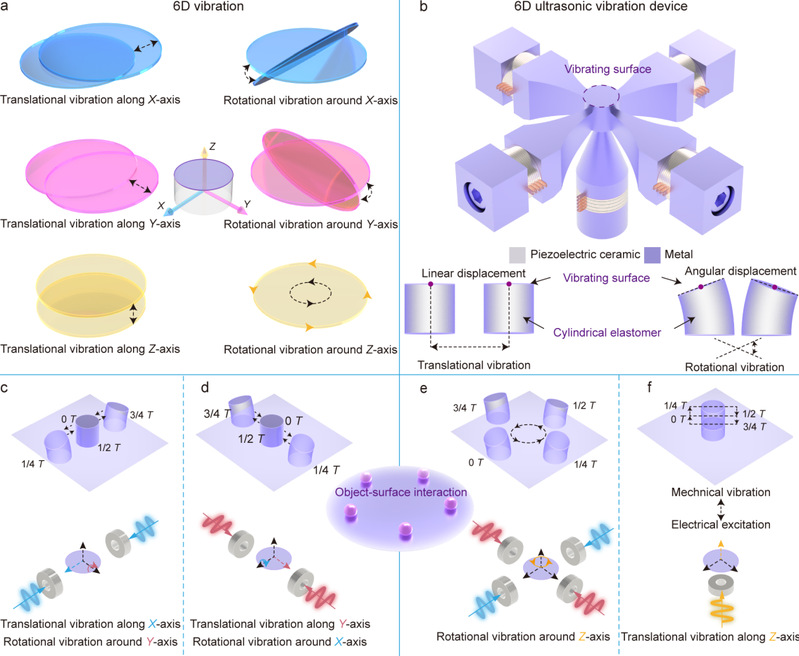 Concept and generation method of 6D ultrasonic vibration. [Photo/hit.edu.cn]
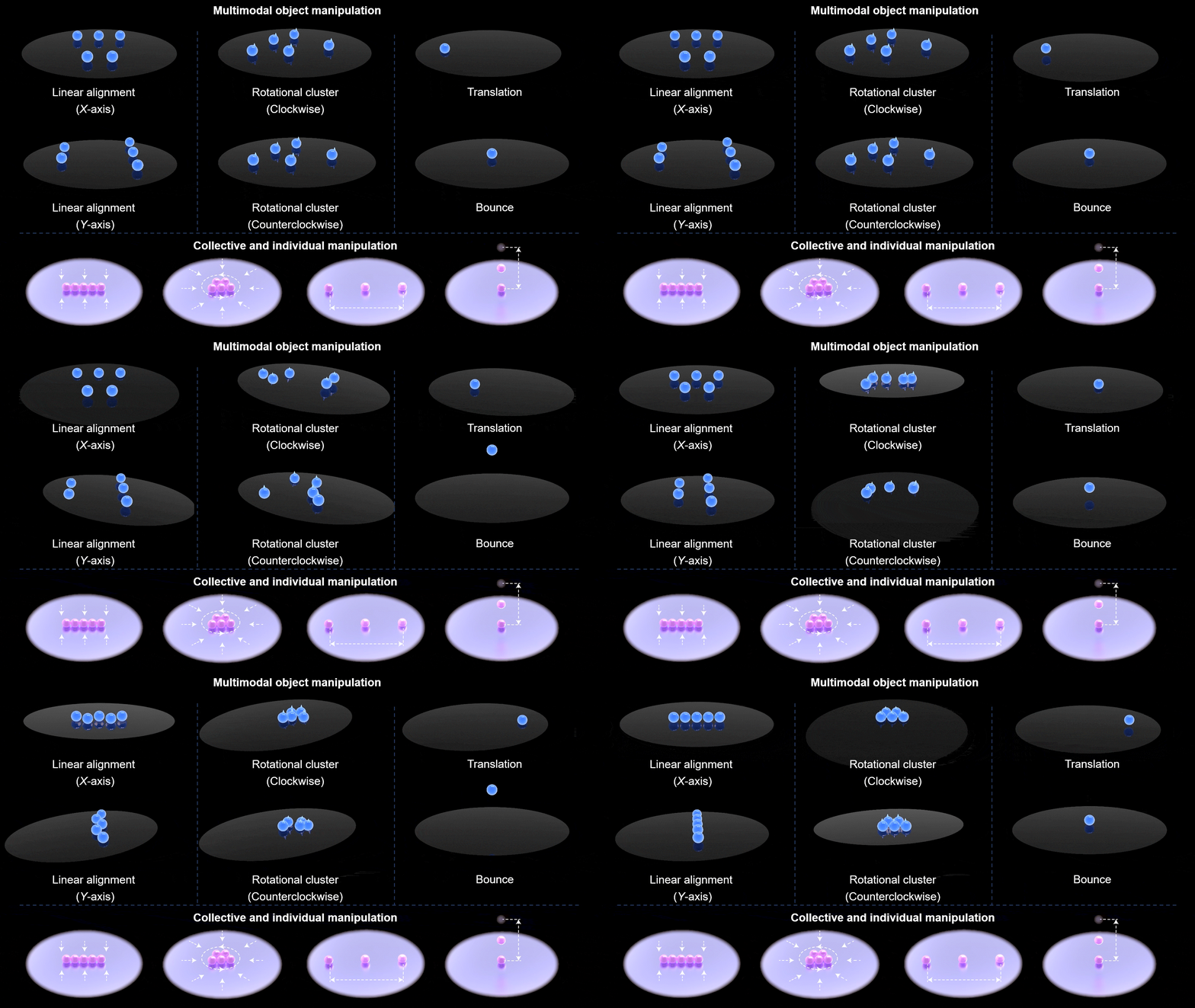 Multimodal object manipulation. [Photo/hit.edu.cn]
The team also demonstrated highly adaptive manipulation of objects with different materials, shapes, and scales. The experimental objects, including spheres, cubes, and cylinders, were made of various materials, including polymers, glass, and metals, and ranged from the micrometer to the centimeter scale. In addition, the team demonstrated the feasibility of manipulating living organisms in multiple degrees of freedom using multidimensional ultrasonic vibration.
They achieved continuous rotation of zebrafish embryos and directed translational movement of shrimp eggs in liquid, providing a new technical approach for multi-angle observation and collective manipulation of living organisms. In summary, this work achieved highly flexible object manipulation using multidimensional ultrasonic vibration, providing an effective solution that combines the simplicity of the manipulation system, the diversity of manipulation modes, and high adaptability of manipulated objects.
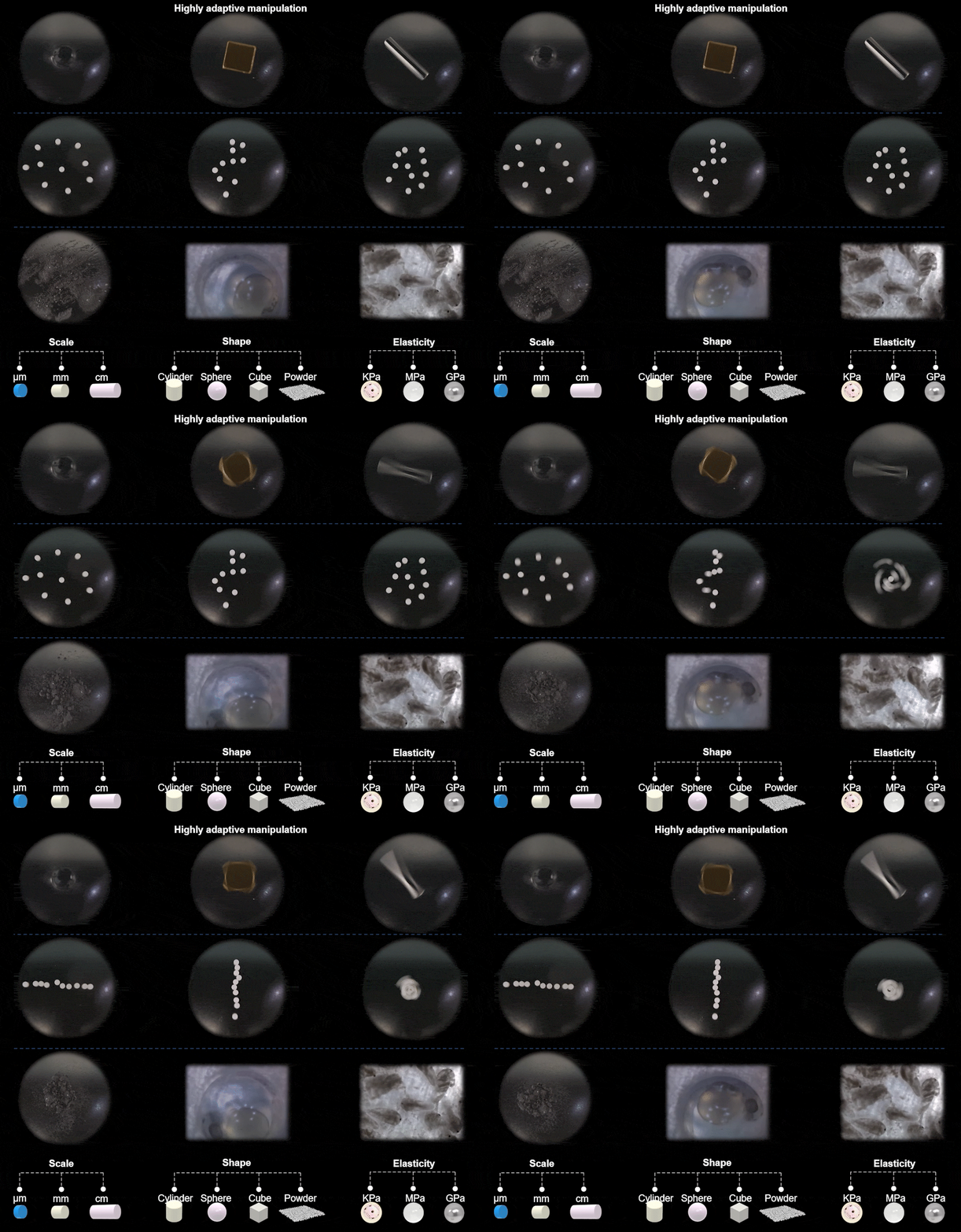 Highly adaptive manipulation.[Photo/hit.edu.cn]
Harbin Institute of Technology is the corresponding institution. Professor Liu is the corresponding author; Zhao Yuzhu, Zhang Shijing, and Yan Jipeng are the co-first authors; and Deng Jie, Li Jing, and Guan Jinghan are the co-authors. This work was supported by the National Natural Science Foundation of China.