

A research team led by Professor Sun Cheng from the School of Architecture and Design at the Harbin Institute of Technology (HIT) has recently achieved significant advances at the intersection of World Heritage conservation and climate awareness assessment. Their findings, titled World Heritage documents reveal persistent gaps between climate awareness and local action, have been published in Nature Climate Change.
Climate change is threatening the conservation of cultural and natural heritage at an unprecedented pace, making the integration of climate adaptation strategies into heritage management a central concern in both academia and politics. However, existing studies have yet to fully illuminate how climate adaptation is incorporated into heritage conservation frameworks.
Addressing this gap, the research team conducted a systematic analysis of 535 World Heritage properties by integrating text-mining techniques with large language models (LLMs). The study uncovers pronounced regional differences and persistent mismatches between climate awareness (vulnerability, adaptability, and resilience) and local action (policy process, planning, and management). The results reveal a marked imbalance in the expression of climate awareness within heritage documents: discussions of vulnerability dominate, whereas adaptation and resilience receive far less attention. Although local-level planning and management actions are relatively frequent, they are negatively associated with vulnerability recognition, while policy-level actions exhibit a positive correlation with overall climate awareness. Furthermore, substantial disparities across regions and linguistic systems highlight the need for enhanced cross-regional collaboration and cross-language knowledge sharing.
This study represents the first application of large language models to World Heritage–related textual analysis, enabling the automated and high-precision evaluation of climate awareness and actions. It demonstrates the potential of LLMs in advancing research at the nexus of heritage and climate, offering new decision-making insights for international organizations and national heritage authorities. The team's "awareness–action" assessment framework allows explicit prioritization of conservation measures, optimization of resource allocation, and facilitation of cross-regional knowledge transfer by comparing local protection documents with international evaluation reports. As an extension of the team's interdisciplinary work in computational design, this research also illustrates the broader applicability of data-driven methods in cultural heritage conservation and human–environment governance, providing refined scientific support for intelligent assessment and coordinated decision-making in complex socio-environmental systems.
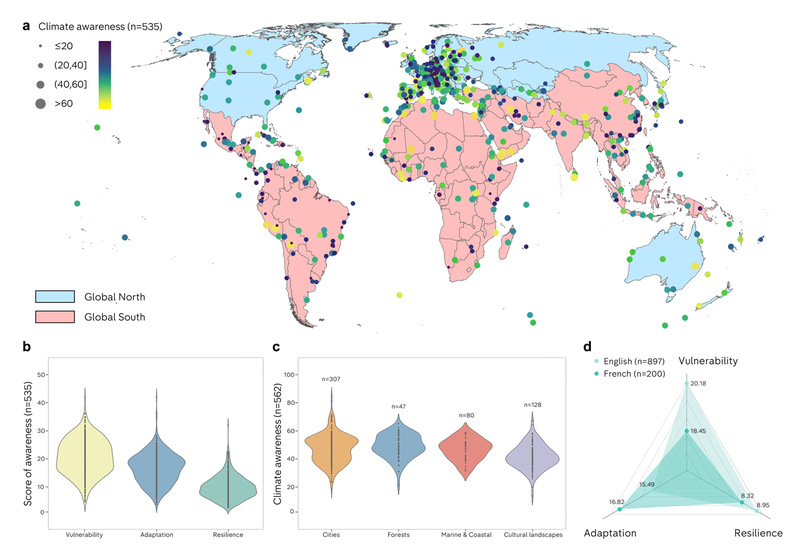
Levels of climate awareness across World Heritage documents exhibit pronounced regional disparities. [Photo/hit.edu.cn]
HIT is the first and sole corresponding institution for the publication. PhD student Yang Chen is the first author, with master's student Dayang Wang and Associate Professor Luchen Zhang serving as major contributors. Professors Cheng Sun and Qi Dong are the corresponding authors.
This work was supported by the National Natural Science Foundation of China, the National Key R&D Program-Strategic Scientific and Technological Innovation Cooperation, the Heilongjiang Touyan Innovation Team Program and the China Postdoctoral Science Foundation.