
A research team led by Professor Han Xiaojun from the School of Chemistry and Chemical Engineering and the State Key Laboratory of Urban-rural Water Resource and Environment, has recently made significant progress in the field of artificial cells. Their findings were published in Angewandte Chemie International Edition under the title Construction of Artificial Cells with Urea Cycle Pathway for Ammonia Detoxification. This work paves the way for constructing functional artificial cells with more complex metabolic networks for biomedical applications.
All metabolic mimicry pathways constructed in artificial cells are linear rather than cyclic, which limits the development of artificial cells. Reconstructing cyclic metabolic pathways within artificial cells remains a significant challenge.
To address the aforementioned challenge, Professor Han's team engineered artificial cells incorporating a urea cycle pathway for ammonia detoxification. This pathway involves carbamoyl phosphate synthetase, ornithine transcarbamylase, argininosuccinate synthetase, argininosuccinate lyase, and arginase, which together convert NH4HCO3 to urea via a cyclic metabolic pathway. Urea was produced inside artificial cells with a conversion rate of 61.9 percent within 120 minutes.
HIT is the sole corresponding institution for this paper. Professor Han and Deputy Researcher Li Shubin from the School of Chemistry and Chemical Engineering are the corresponding authors. Doctoral candidate Ren Tongtong and master’s student Liu Dongliang are the co-first authors. Deputy Researcher Zhao Jingjing, Deputy Researcher Zhang Xiangxiang, Assistant Researcher Xu Wenxia, and doctoral candidates Shi Changxin and Wang Weichen also contributed to this work.
This work was supported by the National Natural Science Foundation of China and the Natural Science Foundation of Heilongjiang Province.
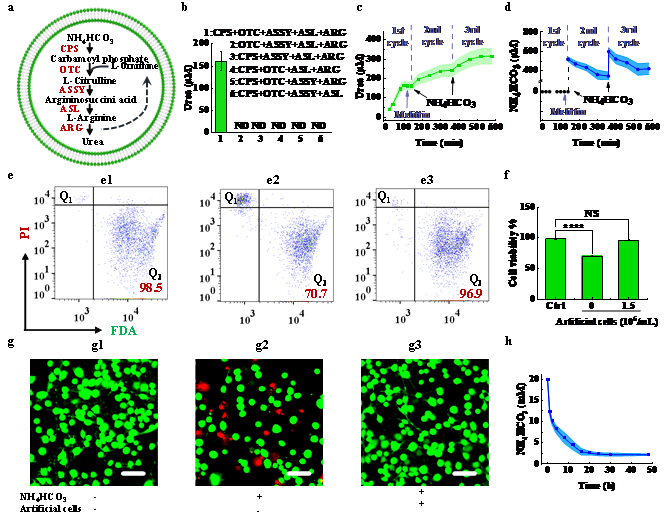
The construction of artificial cells containing a urea cycle pathway for ammonia detoxification. [Photo/hit.edu.cn]