

Professor Du Chunyu's team from the School of Chemistry and Chemical Engineering at Harbin Institute of Technology (HIT) has developed an operando non-destructive mapping technique that reveals the internal processes of commercial lithium-ion batteries using external magnetic fields.
The study, titled Operando mapping of the dynamic evolution of spatially inhomogeneous reactions in commercial batteries, has been published in the prestigious journal Joule.
The fundamental challenge in battery research is that critical internal reactions are invisible and their dynamic evolution is difficult to analyze. To address this challenge, the team established a quantitative mapping relationship between external magnetic fields and internal current density, and developed a magnetic-field-based imaging approach to resolve the spatiotemporal evolution of internal electrochemical reactions. The team also designed and constructed a high-sensitivity, low-noise, fully automated operando magnetic-field testing system, enabling accurate tracking of internal reaction distributions in lithium-ion batteries. Using this technique, the team revealed the self-regulating dynamic feedback mechanism within batteries.
This technique can accurately identify latent design and manufacturing defects, analyze internal battery states under different operational, structural, and mechanical stress conditions, and provide new pathways for electrode design optimization, degradation mechanism analysis, early-stage diagnosis of localized anomalies, and quality control in battery manufacturing.
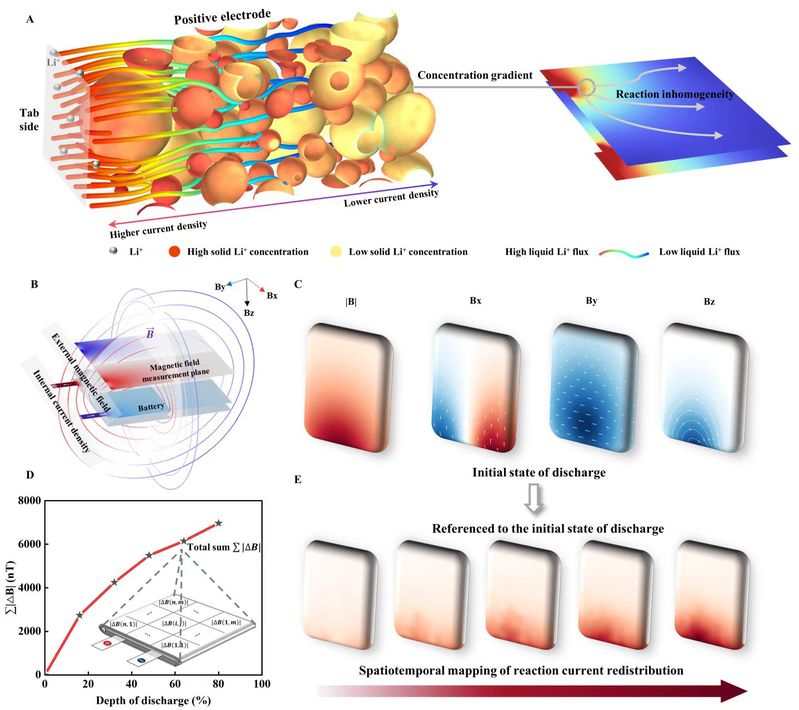
Spatiotemporal mapping of internal inhomogeneous reactions in commercial batteries via external magnetic field measurements. [Photo/hit.edu.cn]
HIT is the first completion unit of the paper. PhD student Zhao Huai'an from the School of Chemistry and Chemical Engineering is the first author, and Professor Du is the corresponding author.
Professor Yin Geping, Deputy Researcher Han Guokang, Assistant Researcher Du Jiannan, and PhD students Xiang Lizhi, Cui Binghan, Zhou Qingjie, Li Sai, and Liu Zheng participated in relevant research work.