
A research team, led by professors Fei Weidong and Wang Lidong from the School of Materials Science and Engineering at Harbin Institute of Technology (HIT), and Associate Researcher Sheng Jie from HIT's Laboratory for Space Environment and Physical Science, has developed a solid-flames upcycling technique for the sustainable management of carbon fiber waste.
Their findings, titled Upcycling carbon fiber wastes in solid-flames, were published in Nature Communications.
Achieving the efficient, high-value recovery of carbon fiber waste remains a critical global challenge.To address this, the research team developed a solid-flames upcycling technique to upcycle the carbon fiber waste into graphene-grafted carbon fibers (GCFs) and graphene powder based on the self-propagating high-temperature synthesis (SHS) from magnesium (Mg) and calcium carbonate (CaCO3) powders.
Microstructural analyses reveal that C-C covalent bonds are formed at the graphene-carbon fiber interface. This molecular bonding (namely grafting) ensures high-strength adhesion, allowing the GCFs to exhibit reinforcement properties that even surpass those of virgin carbon fibers.
The mechanistic study highlights the pivotal role of Mg in the solid-flames. Through an electron transfer effect, Mg significantly weakens the bond dissociation energy of aryl-oxygen bonds within decomposition intermediates from epoxy resins, facilitating the cleavage of C-O bonds and the subsequent interconnection of C-C bonds, driving the transformation of epoxy resin into graphene and the grafting of graphene onto the defect sites of the carbon fibers.
Life cycle assessments indicate that, compared to traditional thermal recycling and incineration, this solid-flames upcycling technology features a substantially lower global warming potential (GWP) and cumulative energy demand (CED), offering a greener path for the composite industry.
HIT is the only corresponding institution for this study. Doctoral student Ren Qingtan from HIT's School of Materials Science and Engineering is the first author. Professor Wang and Associate Researcher Sheng serve as co-corresponding authors.
This research was supported by a major national science and technology infrastructure facility – the Space Environment Simulation Research Infrastructure (SESRI).
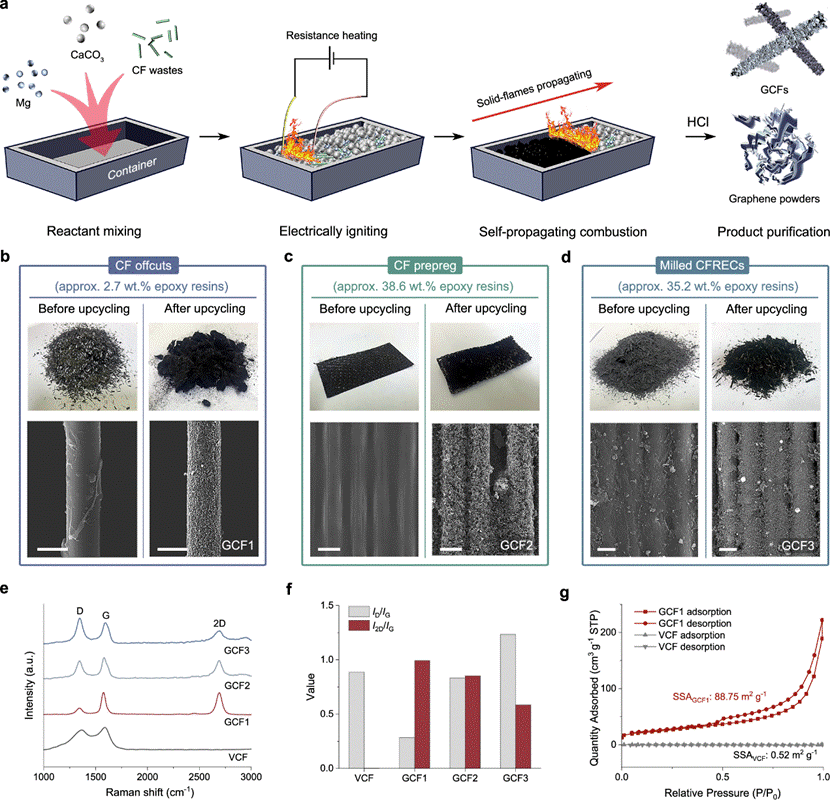
Figure: Upcycling CF wastes in solid-flames. a Schematic diagram of solid-flames upcycling technique. b–d Experimental photos and SEM images of three typical CF wastes before and after upcycling: b CF offcuts and GCF1. c CF prepreg and GCF2. d Milled CFRECs and GCF3. Scale bars, 5 μm (b–d). e Raman spectra of VCF and three GCF samples (GCF1-3). f The ID/IG and I2D/IG values of Raman spectra in (e). g BET adsorption-desorption curves of GCF1 and VCF. CF carbon fiber. GCF graphene-grafted carbon fiber. CFREC carbon fiber reinforced epoxy composites. VCF virgin carbon fiber. SSA specific surface area.