

The research team led by Professor Sui Jiehe at the National Key Laboratory for Precision Hot Processing of Metals of the Harbin Institute of Technology (HIT) has achieved progress in thermoelectric cooling materials. The relevant outcomes have been published in Nature Materials under the title Anodic Protection Enables Moisture-Stable Mg3(Sb, Bi)2 for Thermoelectric Cooling.
Mg3(Sb, Bi)2-based thermoelectric materials, featuring light weight, high strength, high performance, and low cost, are regarded as next-generation candidates to replace traditional bismuth telluride systems. However, their susceptibility to oxidative corrosion in air remains the main obstacle to engineering applications.
Based on the fundamental principles of materials science and electrochemistry, Professor Sui’s team proposed an innovative strategy of in-situ precipitated anodic phases protecting the matrix and developed a new design method for corrosion-resistant composite materials guided by the creation of "multi-objective" precipitated phases. This method significantly improves the moisture stability of the materials without sacrificing their thermoelectric performance. The corrosion rates of the Mg3(Sb, Bi)2-based thermoelectric materials after modification were reduced by 86 percent and 92 percent in water and air, respectively. The fabricated cooling module maintains stable performance after 28 days of aging under harsh conditions – 350 Kelvin (K) high temperature and 70 percent relative humidity (RH) – solving the material’s stability challenges across storage, transportation, processing, and application, and paving the way for its industrialization. In addition, this study provides a new approach and solution for the development of active protection technologies for other moisture-sensitive functional materials.
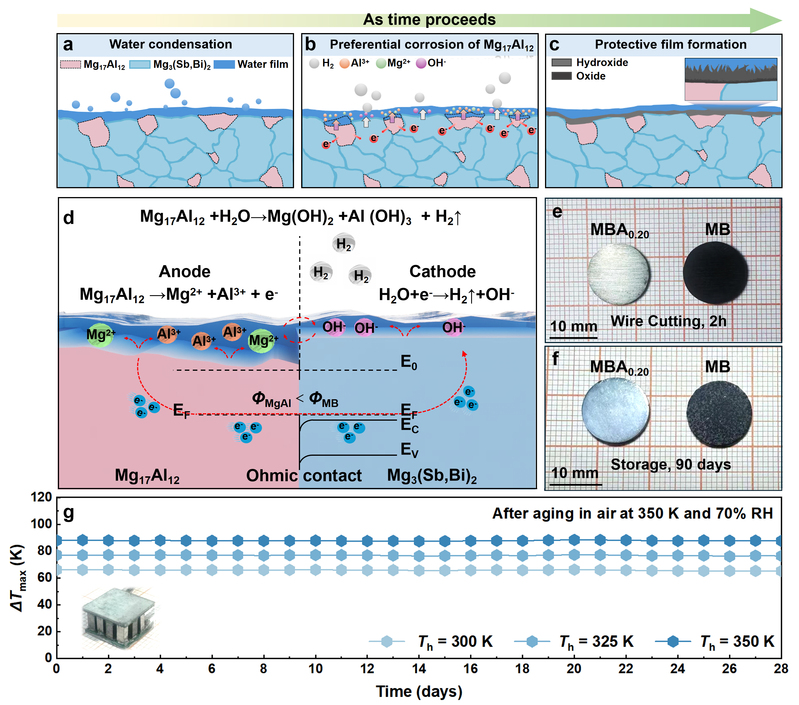
Strategies for moisture stability enhancement and stability validation of materials and devices. [Photo/hit.edu.cn]
HIT is the primary authoring institution. Doctoral student Yu Zhiyuan from the School of Materials Science and Engineering at HIT, doctoral student Sun Yuxin from the University of Hong Kong, and Professor Wu Haijun from Xi'an Jiaotong University share co-first authorship. Co-corresponding authors include Professor Sui and Professor Guo Fengkai from HIT's National Key Laboratory for Precision Hot Processing of Metals and Professor Weishu Liu from Southern University of Science and Technology.
This research is supported by the National Key Research and Development Program of China, the National Natural Science Foundation of China, and the Heilongjiang Touyan Team Program.
The full paper is available at: https://www.nature.com/articles/s41563-026-02563-0