

T cells are the core effector cells mediating the body's antitumor immune response. Targeting the TCR-CD3 complex on their surface with antibodies can induce signal transduction and directly activate T cells. The first monoclonal antibody drug developed based on this mechanism, OKT3, was clinically used for anti-rejection therapy in organ transplantation. However, while potently activating T cells, OKT3 also triggers a massive release of inflammatory cytokines, leading to life-threatening cytokine release syndrome (CRS).
Subsequent antibody engineering efforts have generally adopted a compromise strategy of reducing antibody affinity to improve safety. Although this strategy has led to a new generation of immunosuppressive drugs, it often comes at the cost of compromising T-cell cytotoxic function. Therefore, maintaining the potent antitumor activity of T cells while avoiding excessive cytokine release has become a critical challenge that requires urgent attention.
To investigate the molecular mechanisms of TCR-CD3-mediated T cell activation by antibodies, a research team at Harbin Institute of Technology (HIT) generated a panel of monoclonal antibodies that target this complex. Among them, an antibody designated 4B1 exhibited high affinity for TCR-CD3, surpassing the classic antibody OKT3.
Phenotypic and functional assays revealed that although 4B1 was comparable to UCHT1, another high-affinity antibody, and superior to OKT3 in stimulating the expression of the early activation marker CD69 and upregulating the effector molecules Granzyme B and Perforin, it induced significantly lower levels of cytokine release (IFN-γ, TNF-α, IL-6). Notably, these cytokine levels were much lower than those elicited by the lower-affinity antibody OKT3, directly challenging the prevailing notion that higher antibody affinity correlates with higher cytokine release levels.
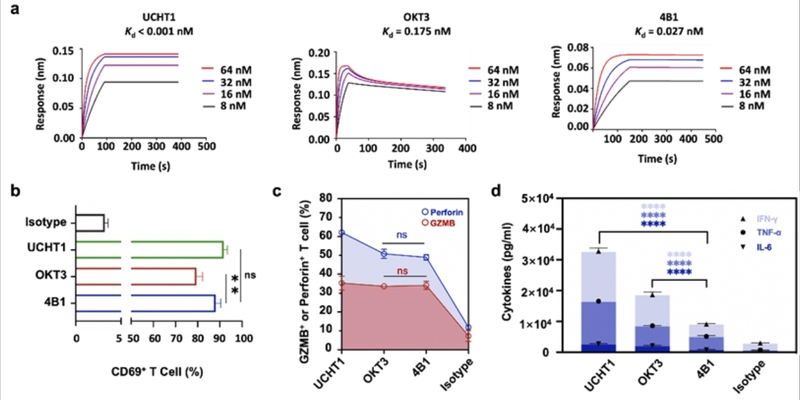
The identification of a novel TCR-CD3-targeting antibody with high binding affinity and low cytokine release.[Photo/hit.edu.cn]
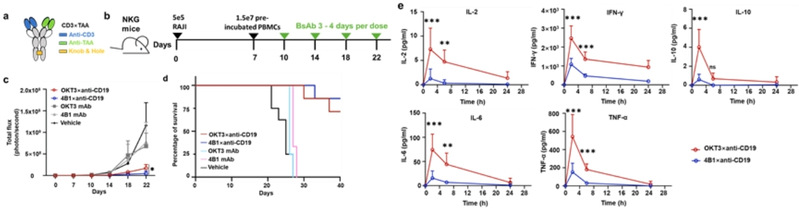
In tumor-bearing mouse model experiments, the 4B1 bispecific antibody not only eliminated tumors more thoroughly than the OKT3 bispecific antibody, but also induced significantly lower levels of inflammatory cytokines.
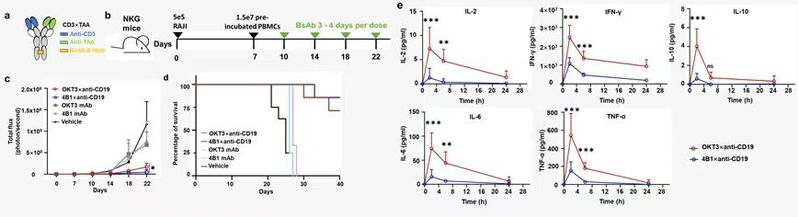
The 4B1 BsAb achieves a more efficient Raji cell-killing effect and triggers significantly lower cytokine release than OKT3 BsAb in humanized mice.[Photo/hit.edu.cn]
The team resolved the structures of 4B1 and OKT3 in complex with the TCR-CD3 complex, revealing that OKT3 can simultaneously bind two CD3ε subunits on the TCR-CD3 complex (2:1 binding). This mode induces large-scale clustering of TCR-CD3 complexes on the cell surface, triggering massive release of inflammatory cytokines.
In stark contrast, because of the unique binding angle of the 4B1 antibody (rotated approximately 45 degrees relative to OKT3), it encounters steric hindrance from the TCRβ subunit, allowing only one 4B1 antibody molecule to bind to one CD3ε subunit (1:1 binding). This mode results in only small-scale aggregation of TCR-CD3 complexes, enabling T cells to release granzymes for tumor killing without causing excessive cytokine release.
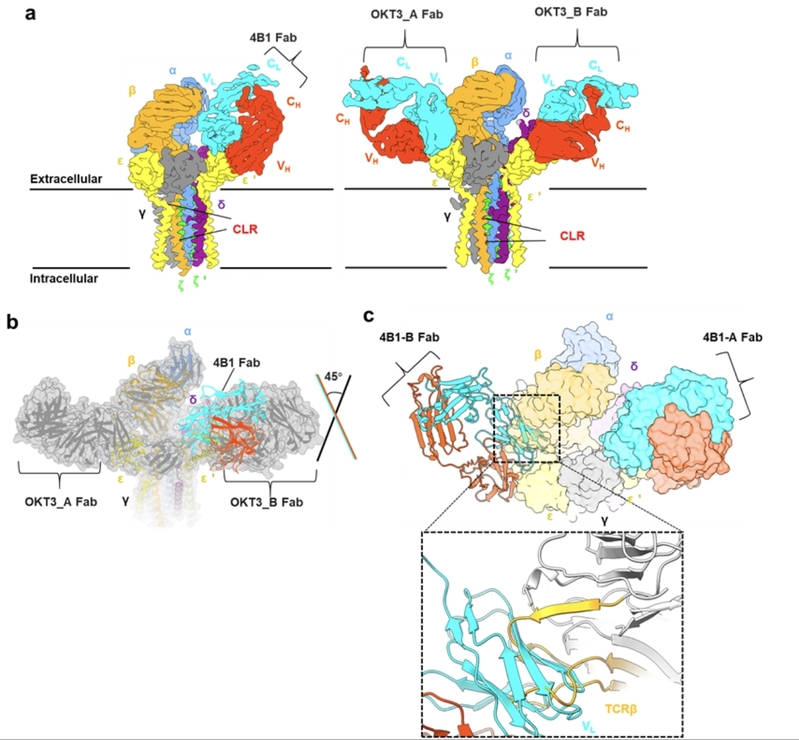 Unlike OKT3, which binds two CD3ε subunits, 4B1 only binds the CD3ε subunit within CD3δε.[Photo/hit.edu.cn]
This study proposes a new paradigm for T cell activation: by targeting specific physical epitopes, achieving biased activation of T cells that significantly suppresses the production of inflammatory cytokines without compromising immune killing efficacy. In the past, modulating T cell activity relied primarily on altering antibody affinity. However, this study demonstrates that the mode of antibody binding is equally important, and even more critical.