

HIT Media (Reported by Li Shuangyu, Gong Yuxiang / Photographed by Gong Yuxiang)
Professor Sui Jiehe and Professor Liu Zihang from the School of Materials Science and Engineering at Harbin Institute of Technology (HIT), together with the research group led by Professor Yu Yuan from RWTH Aachen University in Germany, carried out research on key scientific issues regarding the long-term stability of n-type Mg3(Sb,Bi)2 thermoelectric materials, revealing the intrinsic aging behavior and mechanism of this material under room-temperature inert environment conditions at the real-space scale.
The relevant research findings were published in Physical Review X under the title Real-space visualization of the intrinsic aging in n-type Mg3(Sb,Bi)2 thermoelectrics.
Evaluations of long-term material stability typically focus on the resistance of materials to external environmental disturbances – such as thermal cycling, chemical corrosion, and mechanical stress. However, for metastable materials, whether the relaxation of internal intrinsic defects leads to performance degradation in the absence of external environmental stimuli remains a critical yet under-explored fundamental scientific question.
By combining multiple advanced characterization techniques and theoretical simulation calculations, this study achieved in situ tracking and visual characterization of the intrinsic aging process in n-type Mg3(Sb,Bi)2 during prolonged storage in an oxygen- and moisture-free inert atmosphere at room temperature. Even fully isolated from external environmental interferences, the metastable Mg‑rich state of n‑type Mg3(Sb,Bi)2 still undergoes internal‑defect relaxation over storage time.
Mg atoms redistribute from the interior of the grains toward the Mg-deficient grain boundaries. These grain boundaries act as fast-diffusion pathways and, together with the Mg-deficient surfaces, trap migrating Mg atoms. This process leads to a continuous rise in Mg-vacancy concentration within the grains, ultimately degrading thermoelectric performance.
The study highlights that the long-term performance evolution of functional materials is governed not only by external stimuli but also by intrinsic defect relaxation within the materials.
This work extends the prevailing paradigm of material reliability from environmental resilience to intrinsic defect dynamics and establishes a direct connection between defect thermodynamics, kinetic accessibility, and long-timescale property evolution. These findings offer theoretical foundations and a novel framework for developing highly reliable thermoelectric materials and optimizing the stability of other metastable functional materials.
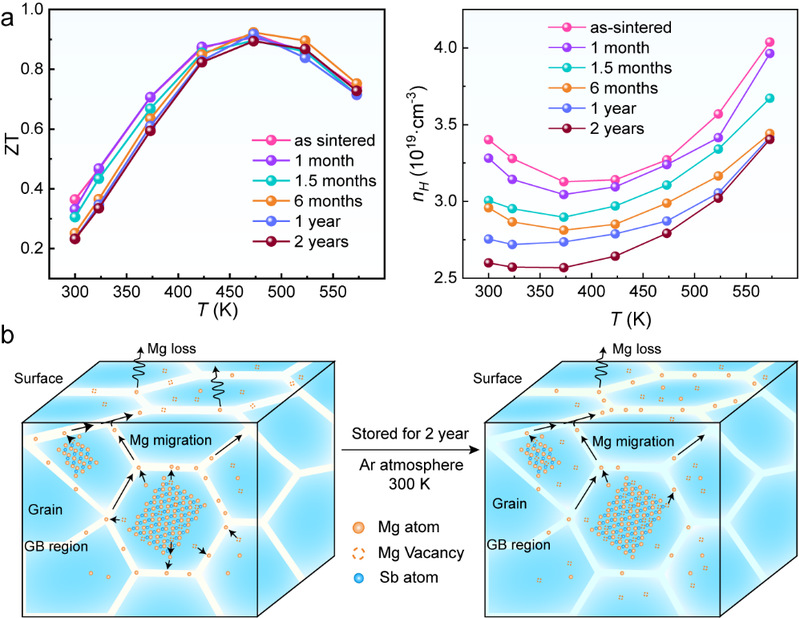
Variations of thermoelectric figure of merit (ZT) and Hall carrier concentration (nH) with temperature for Mg3(Sb, Bi)2 after storage under argon atmosphere for different durations (figure a) and Schematic illustration of the intrinsic aging mechanism of Mg migration-redistribution in Mg3(Sb, Bi)2 (figure b). [Photo/hit.edu.cn]
HIT is the first affiliated institution of the paper. Professor Sui, Professor Liu, and Professor Yu are co-corresponding authors of the paper. Doctoral students Gong Yuxiang and Qu Nuo from HIT's School of Materials Science and Engineering, and doctoral student Sumayya from RWTH Aachen University are co-first authors of the paper. The research was supported by the National Key R&D Program of China and the National Natural Science Foundation of China.