

HIT Media (Text: Kan Simiao, Ding Ke; Photos: School of Mathematics)
The International Congress of Basic Science (ICBS) announced its 2026 selections for the ICBS Innovation Fellowship program on Aug 17, selecting 10 groups of outstanding scholars. Professor Jacob Kryczka of Harbin Institute of Technology (HIT)'s School of Mathematics was among those selected and was named a Liu Hui Mathematics Innovation Scholar.
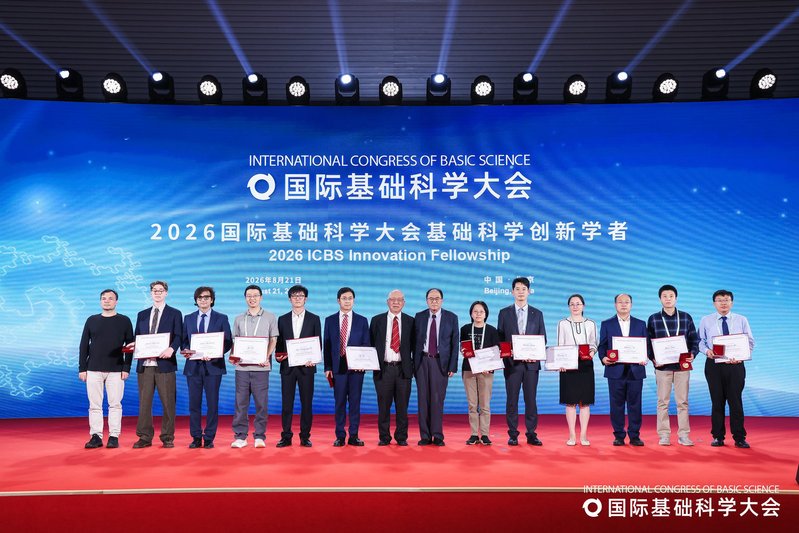 The award ceremony takes place. [Photo/hit.edu.cn]
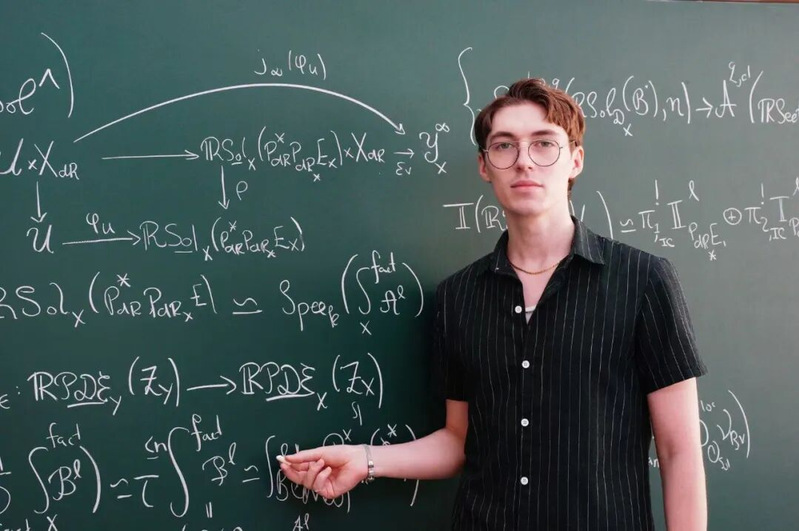 Jacob Kryczka. [Photo/hit.edu.cn]
Kryczka is a full-time professor at HIT. Born in Canada in December 1994, he received his bachelor's and master's degrees from the University of Edinburgh and earned his PhD from the University of Angers in France in 2021. He previously worked at the Beijing Yanqi Lake Institute of Applied Mathematics and the Institute of Mathematics and Informatics of the Bulgarian Academy of Sciences.
His research focuses on differential geometry and equations, with particular interests in the geometric theory of nonlinear partial differential equations, homotopy theory, and derived geometry. In July 2026, he published the paper Derived Moduli Spaces of Nonlinear PDEs: Singular Propagations in the internationally renowned mathematics journal Advances in Mathematics as first author, with HIT as the first affiliation.
The selection process brought together 16 senior scholars from China and abroad, led by six academicians, including Fields Medalists Shing-Tung Yau and Edward Witten. More than 100 experts in the field participated in nominating candidates.
At the suggestion of ICBS Chairman Shing-Tung Yau, the ICBS Innovation Fellowship program established designations in three major fields – mathematics, physics, and engineering – named after four historical Chinese figures: Liu Hui and Zu Chongzhi in mathematics, Zhang Heng in physics, and Li Bing in engineering.
This naming highlights the program's academic mission to be rooted in China and advance scientific progress. The program aims to identify promising early- and mid-career researchers conducting cutting-edge research full-time in China in mathematics, physics, engineering, and other fields. It places particular emphasis on supporting researchers with exceptional innovation potential, fostering original advances in basic research, and establishing a sustained mechanism for nurturing young talent in basic science.
Edited by: Shang Yankai
Reviewed by: Song Ling, Li Shoubin, Yang Wenyu